What Is DeviceNet? How Industrial Communication Works

Industrial automation is the backbone of modern manufacturing. Behind every robotic arm, conveyor belt, and smart sensor lies a communication network that keeps machines talking to each other — reliably, in real time, and without failure. One of the most trusted names in that world is DeviceNet.
Whether you are an automation engineer, a plant manager, or simply curious about how factories actually communicate, this guide gives you everything you need to know. We will also walk you through the role of structured cabling — Cat5e, Cat6, Cat6a, and Cat7 — and show you how to find the right products on Eleczo.
What Is DeviceNet?
DeviceNet is an open industrial communication protocol built on the Controller Area Network (CAN) bus standard. It was originally developed by Allen-Bradley (now Rockwell Automation) in the early 1990s and later transferred to the Open DeviceNet Vendors Association (ODVA), making it a truly open standard used by hundreds of manufacturers globally.
The primary purpose of DeviceNet is to connect industrial devices — sensors, actuators, drives, valves, and controllers — to a single network. Instead of running individual wires for every device, DeviceNet allows multiple devices to share a single cable, dramatically reducing wiring complexity and installation cost.
Quick Fact: DeviceNet supports up to 64 nodes per network segment and operates at speeds of 125 Kbps, 250 Kbps, or 500 Kbps, depending on cable length. |
How Does DeviceNet Work?
DeviceNet uses the CAN bus at its physical and data link layer, with the Common Industrial Protocol (CIP) at the application layer. This combination makes it both robust and flexible.
The Network Architecture
A typical DeviceNet network follows a trunk-and-drop topology:
A main trunk cable runs along the length of the factory floor.
Drop cables branch off the trunk to connect individual devices.
A scanner (master) in a PLC communicates with all connected devices (slaves).
Both power and data are carried on the same cable — 24V DC for device power and differential signaling for data.
Communication Model
DeviceNet uses a producer-consumer model. Rather than point-to-point messaging, data is broadcast on the network and consumed by any node configured to receive it. This model significantly improves efficiency, especially in large installations.
Connections in DeviceNet are classified as:
I/O Messaging — real-time data exchange between devices and the controller.
Explicit Messaging — configuration, diagnostics, and parameter access.
Key Features of DeviceNet
Open Standard: Open Standard managed by ODVA — not locked to any one vendor
Multi-Node: Supports up to 64 nodes on a single segment
Combined Power & Data: Simultaneous power and data on a single 5-wire cable
Flexible Speeds: Speeds: 125 Kbps (500 m), 250 Kbps (250 m), 500 Kbps (100 m)
Hot-Swap Support: Hot-swap capability — devices can be added or removed without shutting down the network
Built-in Diagnostics: Diagnostics and fault reporting built into the protocol
Multi-Vendor: Interoperability across brands — mix Siemens, Omron, Rockwell devices on the same network
Where Is DeviceNet Used?
DeviceNet has proven its reliability across some of the most demanding environments in industry:
Automotive manufacturing — assembly lines, robotic welders, paint shop conveyors
Food and beverage — filling lines, packaging machines, pasteurisation systems
Material handling — automated storage, conveyor systems, sortation equipment
Building automation — HVAC control, access systems, elevator controls
Oil and gas — pump controls, valve actuators, remote I/O in hazardous areas
Pharmaceutical — batch process control, cleanroom equipment
Industry Note: According to ODVA, DeviceNet is one of the most widely deployed fieldbus networks globally, with millions of installed nodes across automotive, process, and discrete manufacturing industries. |
DeviceNet vs Other Industrial Networks
Engineers often compare DeviceNet with PROFIBUS, Modbus, and EtherNet/IP. Here is a quick overview of where DeviceNet stands:
DeviceNet vs PROFIBUS: DeviceNet vs PROFIBUS: DeviceNet offers simpler wiring (combined power and data) and is preferred in North American markets. PROFIBUS dominates European installations.
DeviceNet vs Modbus: DeviceNet vs Modbus: Modbus is simpler and older but lacks the rich diagnostics and multi-master support of DeviceNet.
DeviceNet vs EtherNet/IP: DeviceNet vs EtherNet/IP: EtherNet/IP (also CIP-based) offers higher speeds over standard Ethernet, but DeviceNet remains preferred for device-level field networks where cost and simplicity matter.
Industrial Ethernet Cables: Cat5e, Cat6, Cat6a, and Cat7 Explained
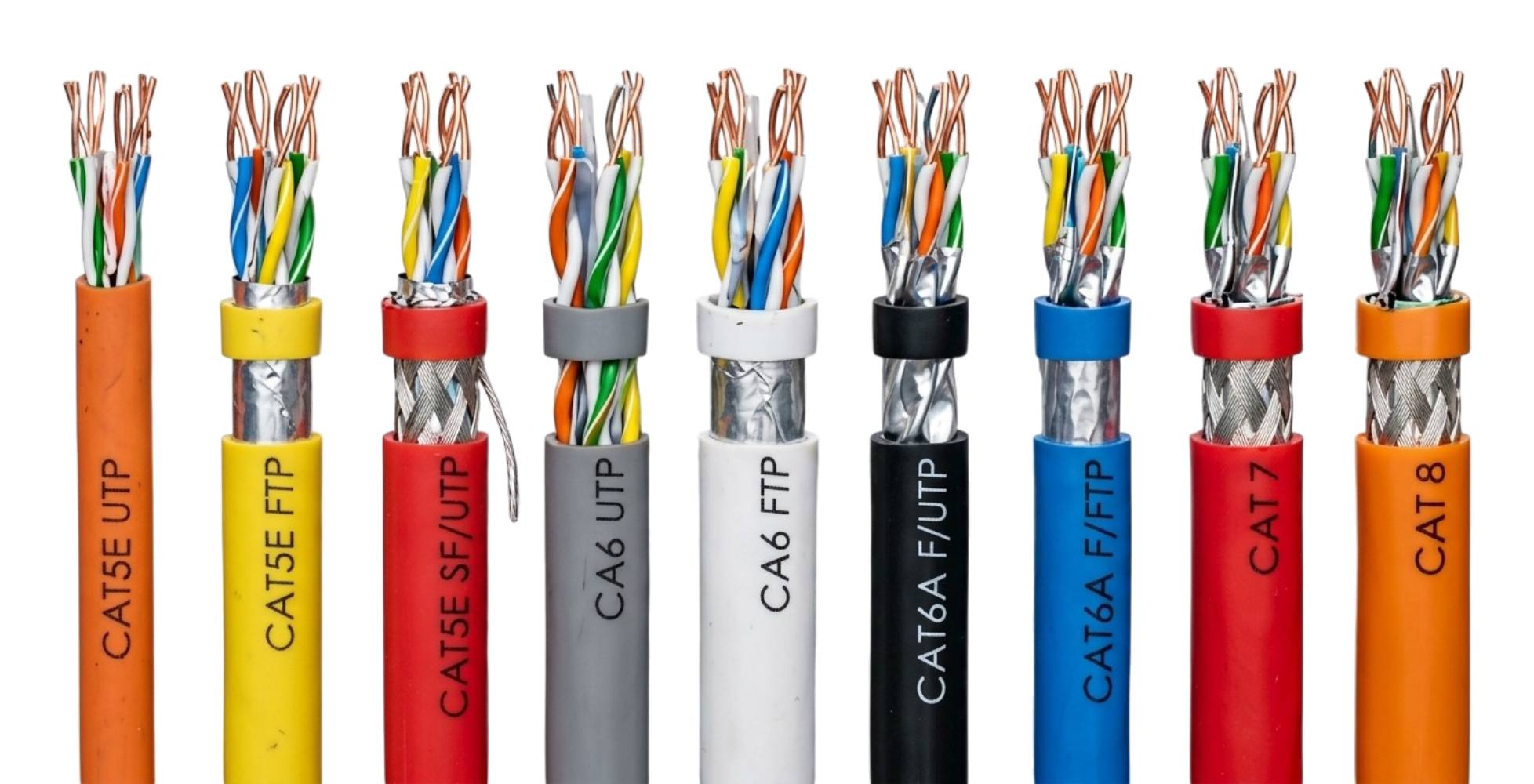
While DeviceNet has its own dedicated cabling (its 5-wire thick/thin cable), modern industrial facilities are increasingly integrating Ethernet-based systems alongside DeviceNet. Cat-rated structured cables form the backbone of office networks, data centres, and increasingly, factory floor Ethernet infrastructure.
Understanding the right network cable to use prevents bottlenecks, reduces downtime, and ensures long-term network performance. Here is a simple breakdown:
Ethernet Cable Comparison
Feature | Cat5e | Cat6 | Cat6a | Cat7 |
|---|---|---|---|---|
Max Speed | 1 Gbps | 1–10 Gbps | 10 Gbps | 10–40 Gbps |
Bandwidth | 100 MHz | 250 MHz | 500 MHz | 600 MHz |
Max Length | 100 m | 55 m (10G) | 100 m | 100 m |
Shielding | UTP | UTP/STP | F/UTP | S/FTP |
Best For | Home/SMB | Office LAN | Industrial/Data Centers | High-Performance |
Cat5e — The Reliable Everyday Cable
Cat5e (Category 5 Enhanced) is the minimum recommended standard for any new installation. It supports Gigabit Ethernet (1 Gbps) over 100 metres and operates at a bandwidth of up to 100 MHz. It is affordable, widely available, and perfectly suited for home networks, small businesses, and general office environments. If your application does not demand 10 Gigabit speeds, Cat5e gets the job done efficiently.
Cat6 — The Smart Office Upgrade
Cat6 delivers up to 10 Gbps at short distances (up to 55 metres) and 1 Gbps over the full 100-metre run. It operates at 250 MHz bandwidth, which means it handles more data with less interference. A tighter twist in the cable pairs and an internal separator (spline) reduce crosstalk. Cat6 is the go-to choice for modern offices, IP surveillance systems, and mid-size businesses looking to future-proof their infrastructure.
Cat6a — The Industrial and Data Centre Standard
Cat6a (Augmented Category 6) is the real workhorse for industrial Ethernet, data centres, and enterprise environments. It sustains full 10 Gbps speeds over the complete 100-metre distance and operates at 500 MHz bandwidth. The thicker insulation and often shielded design make it highly resistant to electromagnetic interference (EMI) — critical in factory environments where motors, inverters, and high-voltage equipment generate significant electrical noise. If you are running Ethernet alongside heavy machinery, Cat6a is the responsible choice.
Cat7 — High-Performance Shielded Cabling
Cat7 pushes performance further with a bandwidth of 600 MHz and potential speeds of up to 40 Gbps at shorter distances. Every pair is individually shielded (S/FTP construction), and the overall cable has an additional outer shield. This double shielding makes Cat7 nearly immune to interference. It is most commonly used in data centres, broadcast facilities, and high-density industrial installations where signal integrity is non-negotiable. Note that Cat7 uses GG45 or TERA connectors rather than the standard RJ45, which is worth factoring into your infrastructure planning.
Which cable should you choose? For home and small business use, Cat5e or Cat6 is sufficient. For industrial environments, server rooms, and data centres, Cat6a is the practical standard. Cat7 is best reserved for the highest-demand installations. |
Find the Right Products on Eleczo.
Eleczo.com is a trusted eCommerce platform specialising in electrical, automation, and networking products. Whether you are sourcing DeviceNet components, industrial connectors, or structured cabling for your facility, Eleczo offers a curated selection from verified brands — with the technical detail you need to make an informed purchase.
DeviceNet & Industrial Networking Products
Eleczo stocks a range of industrial networking components suitable for DeviceNet installations and broader automation infrastructure:
DeviceNet cables (thick and thin trunk cable, drop cables)
Industrial connectors and terminating resistors
DeviceNet scanners and I/O modules
DIN rail-mounted terminal blocks and junction boxes
Industrial Ethernet switches (managed and unmanaged)
Ethernet Cables Available on Eleczo
For structured cabling requirements, Eleczo offers:
Cat5e patch cables and bulk reels — ideal for general networking at competitive prices
Cat6 cables — perfect for office LANs and IP camera systems
Cat6a cables — recommended for industrial Ethernet, server rooms, and high-EMI environments
Cat7 shielded cables — for maximum performance in data centres and broadcast applications
Shop directly at eleczo. and use the search or category filters to find exactly the cable type, length, and specification you need. Product pages include full technical datasheets, brand information, and stock availability so you can buy with confidence.
Pro Tip: When ordering cables for industrial environments, always choose shielded (STP or F/UTP) variants of Cat6a or Cat7. Unshielded cables in high-EMI zones can cause network errors, unexpected downtime, and difficult-to-diagnose performance issues. |
Conclusion
DeviceNet remains one of the most dependable industrial communication protocols in the world. Its open architecture, combined power and data transmission, multi-vendor support, and proven reliability in demanding environments make it a smart choice for device-level networking in factories and process plants.
Paired with the right structured cabling — Cat5e for basic needs, Cat6 for office environments, Cat6a for industrial Ethernet, or Cat7 for maximum performance — your network infrastructure is built to handle both today's demands and tomorrow's growth.
Ready to source the right cables and industrial networking components? Explore the full range at Eleczo. — where technical accuracy meets product availability.
Frequently Asked Questions
Is DeviceNet still relevant in 2025?
Yes. While EtherNet/IP has grown in popularity, DeviceNet remains widely deployed in existing installations and continues to be specified for new projects, particularly in automotive and material handling applications. Its robustness, open standard, and multi-vendor support make it a long-lived technology.
Can DeviceNet and Ethernet coexist in the same facility?
Absolutely. Most modern factories use a layered network approach: DeviceNet or PROFIBUS at the device level, with EtherNet/IP or standard Ethernet at the control and enterprise level. A gateway or bridge connects the two networks.
What is the maximum cable length for DeviceNet?
The maximum trunk cable length depends on the baud rate: 500 metres at 125 Kbps, 250 metres at 250 Kbps, and 100 metres at 500 Kbps. Drop cable lengths are limited to 6 metres (thick cable) or 3 metres (thin cable) per drop.
Is Cat6a better than Cat6 for industrial use?
For industrial environments, yes. Cat6a sustains 10 Gbps over 100 metres and its shielded variants offer significantly better EMI rejection compared to Cat6. In environments with heavy electrical equipment, the performance difference is meaningful.