What Is Structured Cabling? Components and Benefits

If you have ever walked into an office, a school, or a data centre and seen a tidy bundle of cables neatly running along the walls — that is structured cabling at work. But what exactly is it, why does every modern building need it, and which cable type should you choose?
This guide explains everything in plain, simple language — from the basics of a structured cabling system to the key differences between Cat5e, Cat6, Cat6A, and Cat7 network cables. By the end, you will know exactly what to buy and why.
What Is Structured Cabling?
Structured cabling is a standardised system of cabling and related hardware that provides a complete telecommunications infrastructure for a building or campus. Instead of having random cables running in different directions for different devices, structured cabling organises everything in a planned, uniform way.
Think of it like the plumbing in a house. You do not just run pipes wherever they fit — you plan a system that works neatly, reliably, and can be easily maintained. Structured cabling does exactly that for your internet, phones, security cameras, and other connected devices.
Did You Know? According to Uptime Institute's 2024 Resiliency Survey, networking and connectivity issues are the leading cause of IT outages, responsible for 31% of all incidents. A well-planned structured cabling system dramatically reduces this risk. |
The 6 Main Components of a Structured Cabling System
A proper structured cabling system has six core subsystems. Understanding these helps you plan the right setup for your home or business.
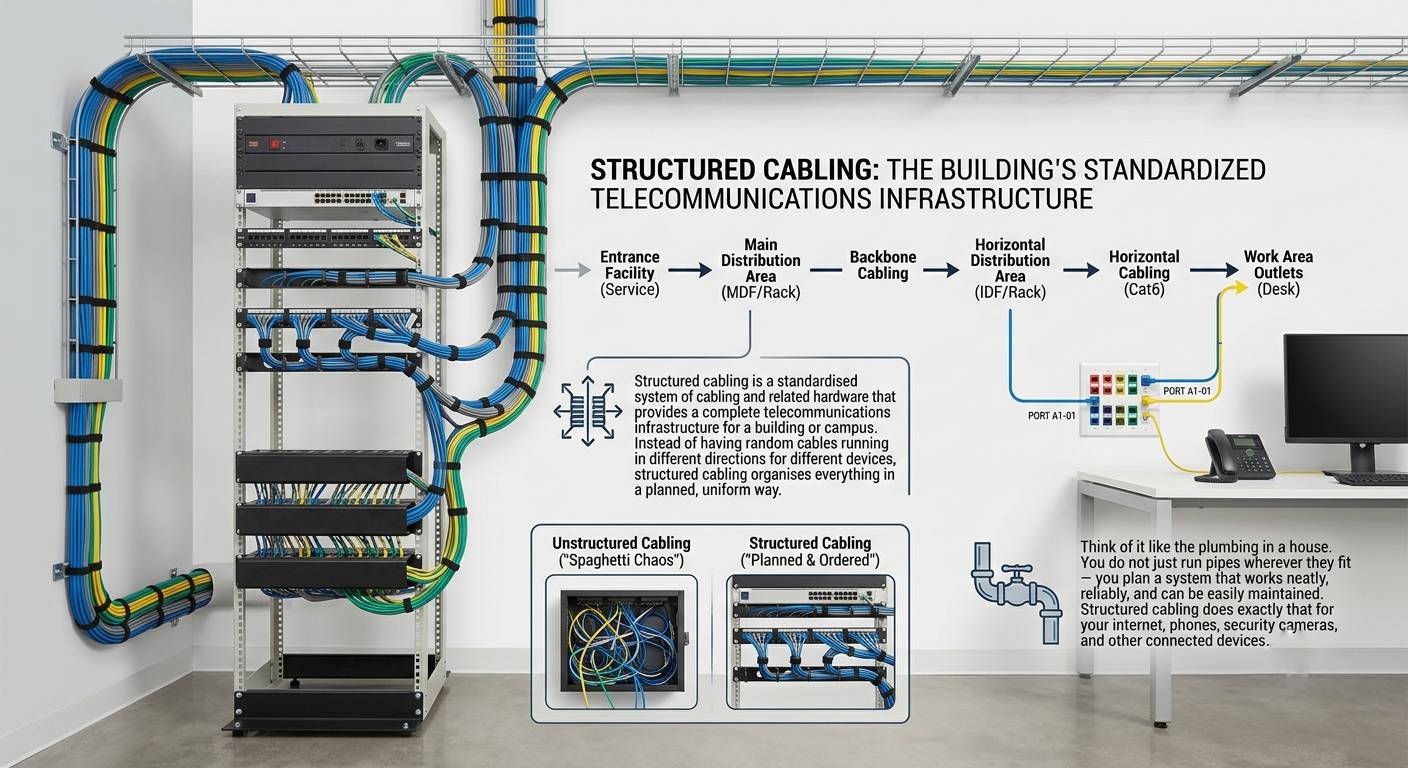
1. Entrance Facility
This is the point where external cables (from your internet service provider or telephone company) enter your building. It is the starting point of your internal network.
2. Equipment Room
The equipment room houses your main networking hardware — servers, routers, switches, and patch panels. It connects the backbone cabling to the rest of the building.
3. Backbone Cabling (Vertical Cabling)
Backbone cabling connects different floors, buildings, or sections of a campus. It handles the heaviest data traffic and typically uses high-speed fibre optic or heavy-duty copper cables.
4. Telecommunications Room (Telecom Closet)
Each floor or section usually has its own telecom closet. This is where the backbone meets the horizontal cabling for that area.
5. Horizontal Cabling
Horizontal cabling runs from the telecom closet to each wall socket or device outlet in the work area. This is the part most people see — the cables running along ceilings or inside walls. Cat5e, Cat6, Cat6A, and Cat7 cables are most commonly used here.
6. Work Area
The work area is where your devices connect — computers, IP phones, printers, wireless access points, and security cameras. The cables plug into wall outlets, which connect back through the entire system.
Why Is a Structured Cabling System Important?
You might wonder — can I just run cables however I want? Technically yes, but here is why a proper structured cabling system is worth it:
Reliability — Organised cabling means fewer faults and less downtime. Troubleshooting is fast because everything is labelled and logical.
Scalability — Adding new devices or upgrading speeds is simple. You do not need to redo everything from scratch.
Cost-Effective Over Time — A good installation lasts 15 to 20 years. Investing in quality cables like Cat6A today prevents expensive upgrades later.
Supports PoE (Power over Ethernet) — Modern structured cabling supports IP cameras, access points, and VoIP phones that receive power through the same cable as data.
Cleaner and Safer — No tangled mess of cables means better airflow, easier maintenance, and a safer environment.
Compliance — Structured cabling follows TIA/EIA and ISO/IEC international standards, ensuring your network meets professional and legal requirements.
Internet Cable Types: Cat5e, Cat6, Cat6A, and Cat7 Explained
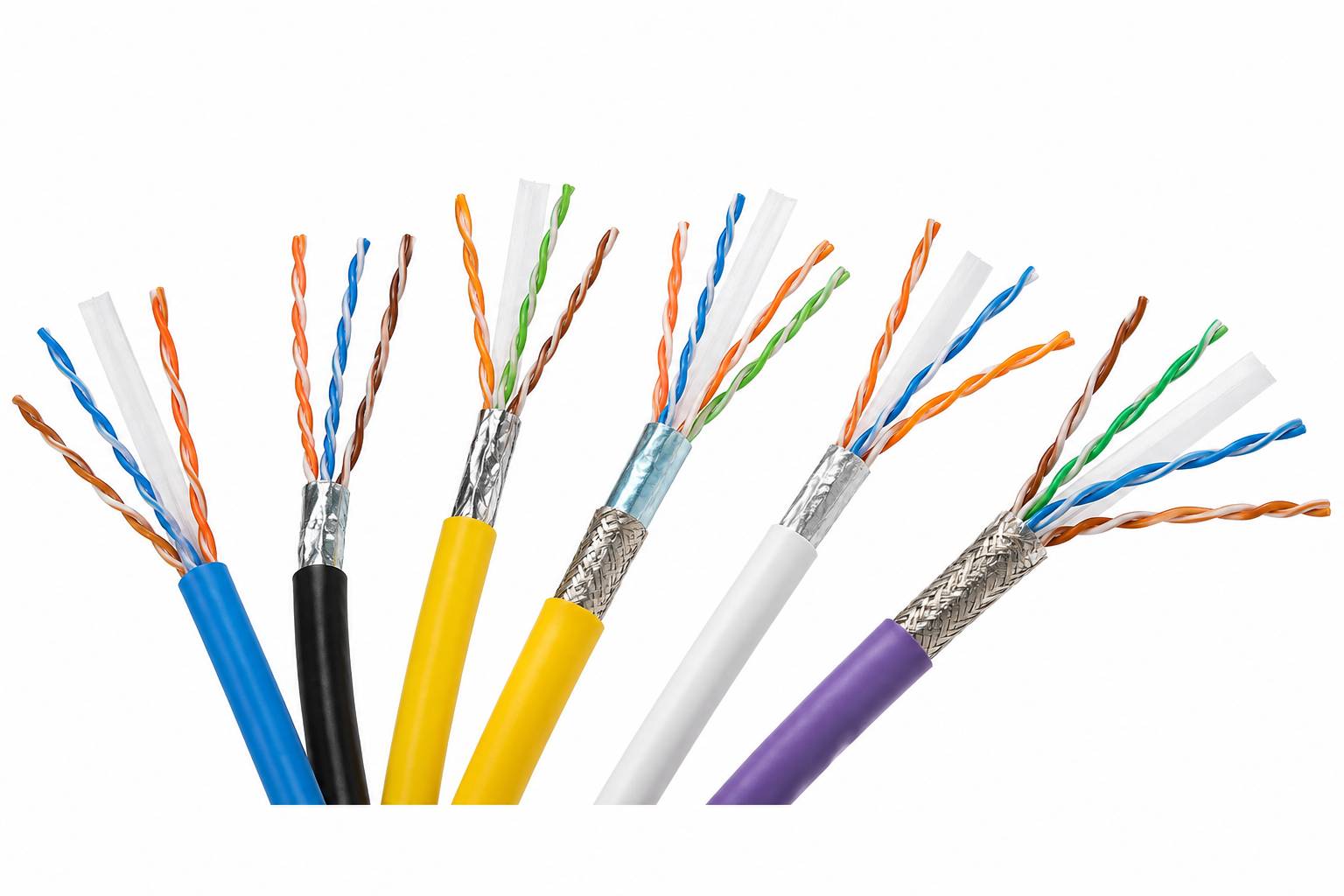
The heart of any structured cabling system is the cable itself. Choosing the right type makes a huge difference in speed, reliability, and future-proofing. Here is a breakdown of the four most popular types.
Cable Type | Max Speed | Bandwidth | Max Distance | Best For |
|---|---|---|---|---|
Up to 1 Gbps | 100 MHz | Up to 100m | Budget Networks | |
Up to 10 Gbps* | 250 MHz | Up to 55m (10G) | Office Networks | |
Up to 10 Gbps | 500 MHz | Up to 100m | Enterprise/Future-proof | |
Up to 10 Gbps | 600 MHz | Up to 100m | Shielded/Data Centers |
Cat6 supports 10 Gbps at shorter distances (up to 55m). For full 100m, use Cat6A.
Cat5e Cable — Reliable and Budget-Friendly
Cat5e stands for Category 5 Enhanced. It supports speeds of up to 1 Gbps and operates at 100 MHz bandwidth. It is one of the most widely used cables in homes and small offices.
Cat5e significantly reduces crosstalk compared to older Cat5 cables, making it more reliable for data transmission. If you are setting up a basic home network or small office where budget matters most, Cat5e is a solid choice.
Best Use Cases for Cat5e Small homes and apartments | Basic office networks | Budget-conscious installations | Low-traffic environments where 1 Gbps speeds are sufficient |
Shop Cat5e cables on Eleczo — trusted brands at the best prices.
Cat6 Cable — The Sweet Spot for Most Users
Cat6 (Category 6) is a step up from Cat5e. It supports up to 10 Gbps over short distances and operates at 250 MHz bandwidth. The cable has a thicker gauge and tighter twist in its pairs, which reduces interference and signal noise.
Cat6 offers improved return loss and far better signal-to-noise ratio compared to Cat5e. It is the most popular choice for home offices, small-to-medium businesses, gaming setups, and everyday networking where higher performance is needed.
Best Use Cases for Cat6 Home offices and medium-sized businesses | Gaming setups requiring low latency | File-heavy environments with frequent large transfers | Wi-Fi router and access point connections |
Looking for Cat6 cables? Browse our full range at Eleczo — available in multiple lengths and colours.
Cat6A Cable — The Future-Proof Standard
Cat6A stands for Category 6 Augmented. It is the most recommended cable for new installations in 2024 and beyond. It supports 10 Gbps at the full 100-metre distance and operates at 500 MHz bandwidth — double that of Cat6.
Cat6A uses tighter twists and improved shielding to dramatically reduce interference, even in dense cable bundles. It also fully supports high-power PoE++ applications, making it ideal for IP cameras, wireless access points, and VoIP systems. The additional cost over Cat6 is modest, and the performance advantage is significant.
According to industry experts, Cat6A has become the baseline standard for new office and commercial installations. A properly installed Cat6A system can last 15 to 20 years, meaning cables installed today will still perform well into the 2040s.
Best Use Cases for Cat6A Enterprise networks and large offices | New construction and commercial fit-outs | Server rooms and data centres | High-density PoE deployments (cameras, access points) | Any installation where future-proofing is a priority |
Future-proof your network today. Shop Cat6A cables at Eleczo, for the best deals on premium Cat6A solutions.
Cat7 Cable — Maximum Shielding for Specialist Use
Cat7 (Category 7) cables support speeds of up to 10 Gbps at 600 MHz bandwidth and feature individual shielding around each twisted pair as well as an overall outer shield. This makes Cat7 extremely resistant to electromagnetic interference (EMI).
It is important to note that Cat7 is not an officially recognised IEEE or EIA standard for general networking — unlike Cat5e, Cat6, and Cat6A. Cat7 uses proprietary connectors rather than standard RJ45 in its full specification. For most offices and homes, Cat6A provides equivalent performance at a lower cost and with better compatibility.
Cat7 is best suited for broadcast control rooms, industrial environments with heavy electrical interference, mission-critical data zones, and facilities where extreme shielding is genuinely required.
Best Use Cases for Cat7 Broadcasting and media production environments | Industrial settings with heavy EMI | Highly specialised data zones | Where individual pair shielding is a strict requirement |
Need Cat7 for a specialist project? Find it at Eleczo.
Which Cable Should You Choose?
Here is a quick decision guide to help you pick the right cable for your needs:
Budget home network or small office: Go with Cat5e. It is reliable and affordable.
General home or business use, gaming, file sharing: Cat6 is the best value choice.
New construction, enterprise networks, or any installation you want to last: Cat6A is the recommended standard.
Industrial, broadcasting, or EMI-heavy environments: Cat7 is worth considering.
For most people in India setting up a structured cabling system today, Cat6 or Cat6A is the right answer. The cost difference is small, and the performance benefit is real.
Where to Buy Quality Internet Cables in India?
When it comes to building a reliable structured cabling system, cable quality matters as much as cable type. A cheap, low-quality cable can underperform even if it carries a Cat6 label.
At Eleczo, we stock a wide range of certified, high-quality internet cables from trusted brands — including Cat5e, Cat6, Cat6A, and Cat7 cables in various lengths, colours, and configurations. Whether you are wiring a single room or setting up a full commercial network, we have the right cable for the job.
Genuine, tested, and certified cables
Competitive pricing with bulk order options
Fast delivery across India
Expert support to help you choose the right cable
Shop Internet Cables at Eleczo. Visit www.eleczo.com and search for Cat5e, Cat6, Cat6A, or Cat7 to browse our complete range of structured cabling products. Build your network with confidence. |
Final Thoughts
Structured cabling is the backbone of any modern network — whether it is in a home, an office, or a large commercial building. Getting it right means choosing the correct cable type, planning your layout properly, and using quality components.
Cat5e works for basic needs. Cat6 is excellent for most users. Cat6A is the smart choice for anyone who wants a network that will perform reliably for the next 15 to 20 years. Cat7 serves specialist, high-interference environments.
Ready to build your structured cabling system? Visit Eleczo, to shop our full range of Cat5e, Cat6, Cat6A, and Cat7 cables. Get the right cable, at the right price, delivered fast across India.
Frequently Asked Questions
Is structured cabling only for big businesses?
Not at all. Even a home with multiple rooms can benefit from structured cabling. It gives you reliable, fast, and organised connectivity for computers, smart TVs, security cameras, and more.
How long does structured cabling last?
A properly installed structured cabling system typically lasts 15 to 20 years. Cat6A cables installed today should comfortably support networking needs well into the 2040s.
Can I mix Cat5e and Cat6 cables in the same network?
Yes, all these cable categories use the same RJ45 connectors and are backward compatible. However, your network will operate at the speed of the slowest cable in the chain, so it is best to use a consistent category throughout.
What is the difference between Cat6 and Cat6A?
Cat6 supports 10 Gbps but only at distances up to 55 metres. Cat6A supports 10 Gbps at the full 100-metre distance and has better shielding and bandwidth (500 MHz vs 250 MHz). For new installations, Cat6A is always the better investment.