Industrial Ethernet Cable Selection Checklist for Engineers

Choosing the right industrial Ethernet cable is one of the most important decisions you will make for any industrial networking project. Get it wrong, and you face slow data transfers, signal interference, unexpected downtime, and expensive rewiring. Get it right, and your network runs reliably for years — even in demanding factory environments.
This guide gives you a clear, step-by-step selection checklist. Whether you are upgrading an existing facility or planning a new installation, this article covers everything you need to know — from cable categories to shielding types, jacket materials, and where to buy certified cables in India.
Why Industrial Ethernet Cables Are Different From Regular Cables
Standard office Ethernet cables are designed for clean, controlled environments. Industrial Ethernet cables face a much harsher world:
High electromagnetic interference (EMI) from motors, drives, and welding equipment
Extreme temperatures — from freezing warehouses to hot manufacturing floors
Mechanical stress — constant movement, vibrations, and bending
Exposure to oils, chemicals, and moisture
Long cable runs — sometimes exceeding 80–90 metres
A regular Cat6 cable from a retail store is simply not built for these conditions. Industrial-grade cables use tougher jacket materials, better shielding, and more durable conductors to handle all of this reliably.
Understanding Cable Categories: Cat5e, Cat6, Cat6A, and Cat7
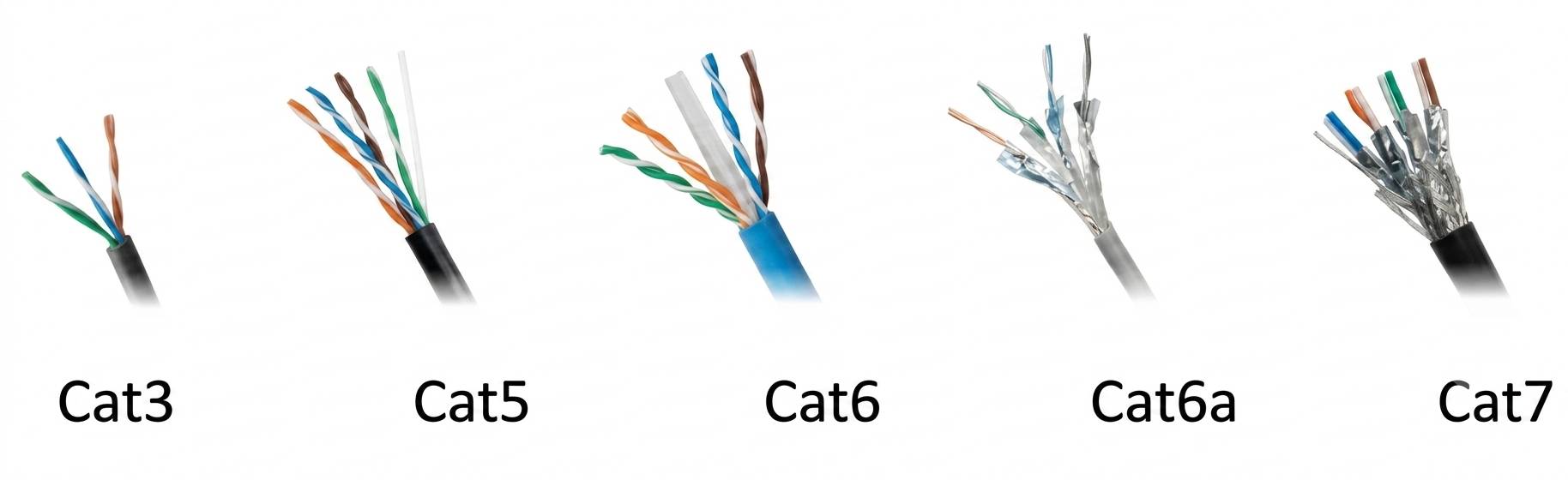
The most important factor in your selection is the network cable category. Each category defines the speed, bandwidth, and performance level of the cable. Here is a simple breakdown:
Cat5e — The Reliable Starting Point
Cat5e (Enhanced Category 5) supports speeds up to 1 Gbps and operates at 100 MHz bandwidth. It handles cable runs up to 100 metres and has been the backbone of Ethernet networks for over 15 years.
In industrial settings, Cat5e is considered the minimum acceptable standard today. It works well in low-interference environments or where existing older infrastructure is being upgraded. However, for new installations in 2025 and beyond, it is best used only when budget is very tight or the network demands are simple (1 Gbps or below).
Speed: 1 Gbps
Bandwidth: 100 MHz
Best for: Light industrial use, retrofits, building automation with low data demand
Cat6 — The Practical Industrial Workhorse
Cat6 cables deliver 10 Gbps speeds but with an important limitation: that top speed is achievable only up to about 55 metres. Beyond that, performance drops to 1 Gbps. Cat6 operates at 250 MHz bandwidth and offers much better resistance to crosstalk than Cat5e.
For most standard industrial networks — SCADA systems, PLCs, IP cameras, and factory floor switches — Cat6 is a solid, cost-effective choice. It is backward compatible with Cat5e equipment, making upgrades straightforward.
Speed: Up to 10 Gbps (55 m) / 1 Gbps (100 m)
Bandwidth: 250 MHz
Best for: Standard factory floors, control rooms, SCADA networks, industrial switches
Cat6A — The Future-Proof Industrial Standard
Cat6A (Augmented Category 6) is the current gold standard for serious industrial deployments. It supports a full 10 Gbps over 100 metres — solving the distance limitation of Cat6 — and operates at 500 MHz bandwidth. Cat6A also has superior shielding, making it far more resistant to electromagnetic interference.
If you are planning a new industrial network in 2025, Cat6A is the recommended minimum for future-proofing. Wi-Fi 6E access points, high-speed industrial cameras, and modern automation systems all benefit from Cat6A's performance and headroom.
Speed: 10 Gbps over full 100 m
Bandwidth: 500 MHz
Best for: High-speed manufacturing, data-intensive automation, future-proof industrial cabling
Cat7 — Maximum Shielding for Extreme Environments
Cat7 cables are fully shielded — each individual wire pair is wrapped in its own foil shield, and then the entire cable has an outer shield as well (known as S/FTP construction). This gives Cat7 outstanding protection against EMI, crosstalk, and electrical noise. It operates at 600 MHz bandwidth and supports 10 Gbps over 100 metres.
Cat7 is the right choice for environments with very heavy electrical interference — near large motors, high-voltage equipment, welding systems, or frequency drives. Note that Cat7 uses proprietary GG45 or TERA connectors for its full rated performance, though many installations still use standard RJ45 connectors (which limits performance to Cat6A levels in most cases).
Speed: 10 Gbps over 100 m
Bandwidth: 600 MHz
Best for: Heavy EMI environments, near motors and drives, high-precision automation
Quick Comparison: Cat5e vs Cat6 vs Cat6A vs Cat7
Use this table as a quick reference before making your cable selection:
Category | Max Speed | Bandwidth | Max Distance | Shielding | Best For |
|---|---|---|---|---|---|
Cat5e | 1 Gbps | 100 MHz | 100 m | UTP | Light industrial, retrofits |
Cat6 | 10 Gbps* | 250 MHz | 55 m at 10G | UTP/STP | Standard industrial networks |
Cat6A | 10 Gbps | 500 MHz | 100 m | F/UTP or S/FTP | High-noise factories, future-proof |
Cat7 | 10 Gbps | 600 MHz | 100 m | S/FTP (fully shielded) | Heavy EMI environments |
Cat6 delivers 10 Gbps only up to approximately 55 metres. Full 100 m runs are limited to 1 Gbps.
Shielding Types: UTP vs STP vs F/UTP vs S/FTP
Shielding is critical in industrial environments. Here is what the different codes mean:
UTP (Unshielded Twisted Pair): No external shielding. Fine for clean office environments with low EMI.
F/UTP (Foiled UTP): A single foil shield around all pairs. Good for moderate industrial EMI.
S/FTP (Shielded, Individually Foiled Pairs): Each pair has its own foil + outer braid shield. Maximum protection. Used in Cat7.
STP (Shielded Twisted Pair): Braid shield over all pairs. Good for high-noise environments.
As a rule of thumb: the more electrical interference in your environment, the more shielding you need. Always ensure the shielding is properly grounded at both ends — poor grounding can actually make interference worse.
Jacket Material Selection for Industrial Environments
The outer jacket protects the cable from physical and chemical damage. The right choice depends on your environment:
PVC (Polyvinyl Chloride): Standard jacket. Cost-effective, flexible, suitable for most indoor industrial environments.
LSZH (Low Smoke Zero Halogen): Required in confined spaces, tunnels, and areas where toxic fumes in a fire would be dangerous. Mandatory in many Indian industrial safety standards.
PUR (Polyurethane): Best for applications with constant movement, oil exposure, or chemical contact. Ideal for drag chains and robot cable trays.
TPE (Thermoplastic Elastomer): Excellent temperature resistance. Used in very hot or cold environments.
The Industrial Ethernet Cable Selection Checklist
Use this 10-step checklist before placing any order. Run through each item systematically to make sure you are selecting the right cable for your project:
Step 1 | Define your required data speed (1G, 10G) |
|---|---|
Step 2 | Measure cable run distances accurately |
Step 3 | Identify EMI sources near the cable path |
Step 4 | Check environment: temperature, moisture, flex requirements |
Step 5 | Select cable category (Cat5e / Cat6 / Cat6A / Cat7) |
Step 6 | Choose shielding type (UTP for low-noise, STP/F-UTP for high-noise) |
Step 7 | Verify jacket material (PVC, LSZH, PUR) for your environment |
Step 8 | Ensure all connectors match the same category rating |
Step 9 | Plan for future bandwidth needs — consider upgrading one level |
Step 10 | Source from a trusted supplier with verified specifications |
5 Common Mistakes Engineers Make When Selecting Industrial Ethernet Cables
Even experienced engineers fall into these traps. Avoid them:
Mistake 1: Choosing Based on Speed Alone Maximum advertised speed is not everything. A Cat6 cable rated for 10 Gbps will only deliver that over short runs (under 55 m). For longer distances, you need Cat6A. |
Mistake 2: Ignoring EMI Sources in the Cable Path Routing Ethernet cables next to power cables, motors, or frequency drives without adequate shielding causes signal degradation and intermittent failures. Always map EMI sources before routing. |
Mistake 3: Mixing Cable Categories in the Same Channel Do not mix Cat5e patch cables with Cat6A runs. The entire channel performs at the level of the weakest component. Use matching-category connectors, patch panels, and keystones throughout. |
Mistake 4: Using CCA (Copper Clad Aluminium) Cables CCA cables look like copper cables but use aluminium cores coated in copper. They have higher resistance, overheat under PoE loads, and can be a fire risk. Always use full-copper (100% bare copper) conductors in industrial settings. |
Mistake 5: Not Planning for Future Bandwidth Installing Cat5e today to save cost can mean expensive rewiring in 3-5 years. Installing Cat6A now often costs only 15-20% more but gives you 10x the bandwidth headroom. |
Where to Buy Industrial Ethernet Cables in India — Eleczo.
Sourcing the right industrial Ethernet cable from a trusted supplier is just as important as knowing which type to buy. Eleczo, is one of India's leading industrial electrical and networking product platforms, stocking a wide range of certified industrial Ethernet cables from leading brands.
Here is what you can find on Eleczo, for your industrial Ethernet requirements:
Cat5e Industrial Ethernet Cables — ideal for light-duty installations, retrofits, and budget-conscious projects where 1 Gbps performance is sufficient.
Cat6 Industrial Ethernet Cables — the reliable workhorse for most industrial networks, SCADA systems, and factory floors with moderate data requirements.
Cat6A Industrial Ethernet Cables — the recommended choice for new installations requiring full 10 Gbps over 100 metres, with superior shielding for high-EMI environments.
Cat7 Industrial Ethernet Cables — fully shielded S/FTP cables for the most demanding environments, including heavy machinery areas and high-interference zones.
All cables on Eleczo, come from verified manufacturers with proper category certifications. You can browse, compare specifications, and place orders online with delivery across India. Visit www.eleczo.com to explore the full range of industrial Ethernet cables available.
Final Thoughts: Make the Right Choice from Day One
Selecting the right industrial Ethernet cables is not complicated — but it does require a systematic approach. Use the checklist in this article to evaluate your speed requirements, cable distances, environmental conditions, and future bandwidth needs before making a decision.
For most new industrial installations in India today, Cat6A is the recommended starting point. It delivers 10 Gbps over full 100-metre runs, handles moderate-to-high EMI well, and gives you years of headroom for network upgrades.
If you are in a particularly harsh environment with heavy machinery and high EMI, step up to Cat7. If your project has tight budget constraints and simple networking needs, Cat5e or Cat6 will serve you well.
Whatever you choose, buy from a trusted source. Browse the complete range of certified industrial Ethernet cables — Cat5e, Cat6, Cat6A, and Cat7 — on Eleczo, and ensure your industrial network is built on a solid, reliable foundation.
Frequently Asked Questions
Q: Can I use Cat7 with a standard RJ45 connector?
Yes, Cat7 cables can be terminated with RJ45 connectors and will work in standard networks. However, to achieve the full Cat7 rated performance at 600 MHz, you technically need GG45 or TERA connectors. In most industrial Ethernet applications, using Cat7 with RJ45 connectors delivers Cat6A-equivalent performance — which is still excellent.
Q: Is shielded cable always better for industrial use?
Shielded cables perform better in high-EMI environments, but only if properly grounded. An improperly grounded shielded cable can act as an antenna and make interference worse. In low-interference environments, quality UTP cables can work perfectly well and are easier to install.
Q: What is the maximum cable length for industrial Ethernet?
The IEEE standard for copper Ethernet is 100 metres (328 feet) for a single cable segment. This applies to Cat5e, Cat6A, and Cat7. Cat6 is limited to 55 metres for 10 Gbps performance but can reach 100 metres at 1 Gbps. For longer distances, use fibre optic cables or managed switches as signal repeaters.
Q: How do I verify a cable meets its rated category?
Ask for test reports from the manufacturer. Reliable suppliers like those listed on Eleczo. provide cables from manufacturers who conduct TIA/ISO compliance testing. You can also verify installed links using a cable certifier tool like the Fluke DSX-600 to confirm the channel meets the required standard.