Ethernet Cable Categories Explained: Complete Guide

If you have ever stood in front of a wall of cables wondering whether to buy Cat5e, Cat6, Cat6a, or Cat7, you are not alone. The labels printed on Ethernet cables look almost identical, yet the differences between them affect your network speed, your maximum cable run length, and how well your connection holds up around motors, machinery, and other sources of electrical noise.
This guide breaks down the four most common ethernet cable categories — Cat5e, Cat6, Cat6a, and Cat7 — in plain language, explains how the official cabling standards define them, clears up a few persistent myths, and helps you match the right cable to your home network, office installation, or industrial automation project.
What Do Ethernet Cable “Categories” Actually Mean?
The “Cat” number on an Ethernet cable refers to a performance category defined primarily by the Telecommunications Industry Association in the ANSI/TIA-568 cabling standard, with a parallel set of categories defined internationally by ISO/IEC 11801. Each category specifies, at minimum, three things: the maximum frequency the cable can carry (measured in megahertz, or MHz), the maximum data rate it supports at that frequency, and the maximum length over which it can maintain that performance, typically 100 meters end to end.
Every twisted-pair Ethernet cable contains four pairs of copper wires twisted together at carefully controlled rates. Tighter, more precise twisting cancels more electromagnetic interference between the pairs, a problem known as crosstalk. As categories increase, manufacturers tighten the twist rate, add internal separators, and in some cases wrap individual pairs or the whole cable in metallic shielding. That is the physical reason a higher category cable can carry more data, more reliably, over a longer distance.
It is worth noting upfront that not every cable category on the market is officially recognized by TIA. Cat5e, Cat6, and Cat6a are all part of the ANSI/TIA-568 standard. Cat7, as you’ll see below, is an ISO/IEC category that TIA never adopted — a detail that matters more than most buyers realize.
Cat5e: The Reliable Gigabit Baseline
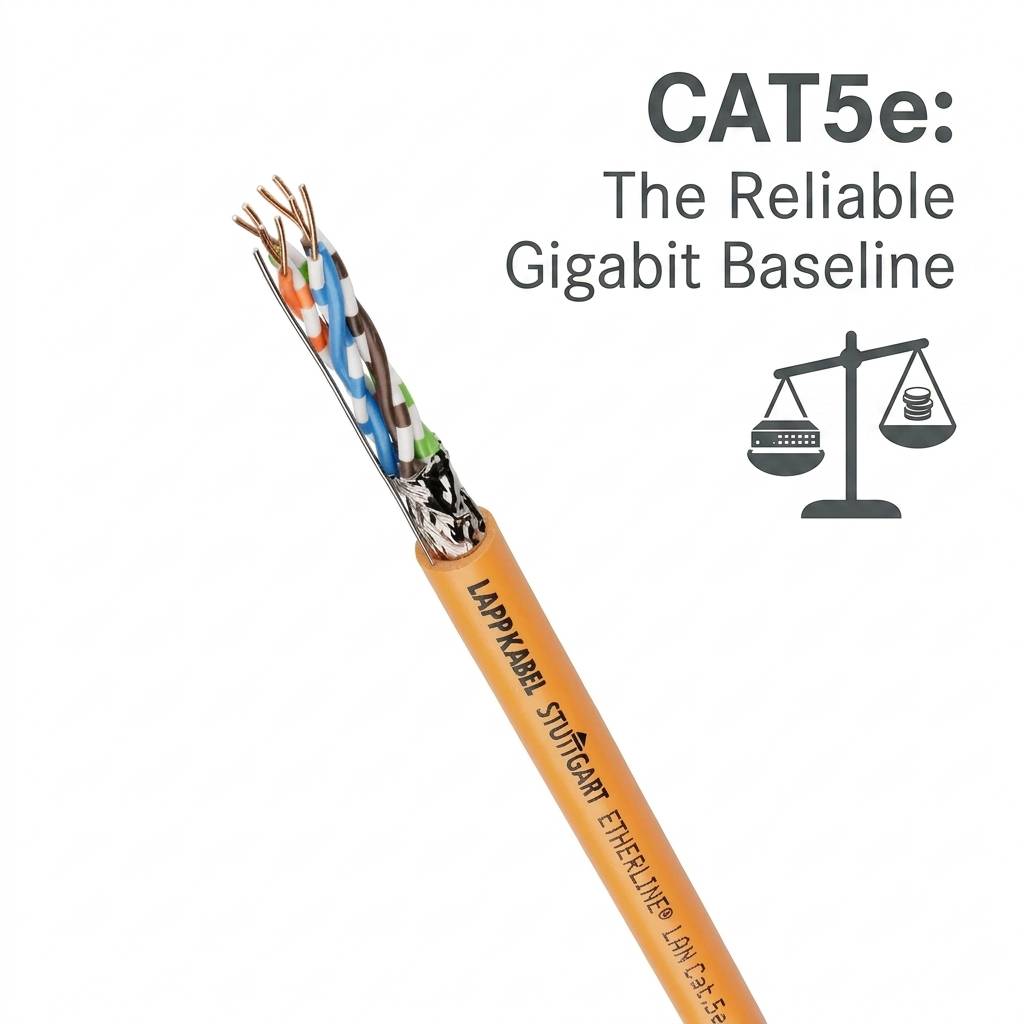
Cat5e (“Category 5, enhanced”) has been the workhorse of wired networking since it replaced the original Cat5 specification in 2001. It is rated to 100 MHz and reliably supports 1000BASE-T, or Gigabit Ethernet, over the full 100-meter channel length. It uses the same four-twisted-pair construction as later categories but with looser twist rates and no internal separators, which keeps it thin, flexible, and inexpensive.
For everyday tasks like web browsing, video calls, and standard office connectivity, a properly installed Cat5e run performs indistinguishably from newer categories, because most home and small-office equipment doesn’t exceed 1 Gbps anyway. Where Cat5e falls short is multi-gigabit and 10-gigabit Ethernet: TIA does not certify it for 10GBASE-T, so it should not be the cable of choice if you are planning to upgrade to faster network hardware in the next few years.
Eleczo stocks LAPP ETHERLINE Cat5e cable in both fixed-installation and flexible constructions, including shielded variants suited to environments with moderate electrical noise. You can browse the available Cat5e options on the Eleczo network cables page — a sensible, budget-friendly choice for standard Gigabit networks, voice/data drops, and legacy system replacements where 10G is not on the roadmap.
Cat6: The Current Sweet Spot for Most Networks
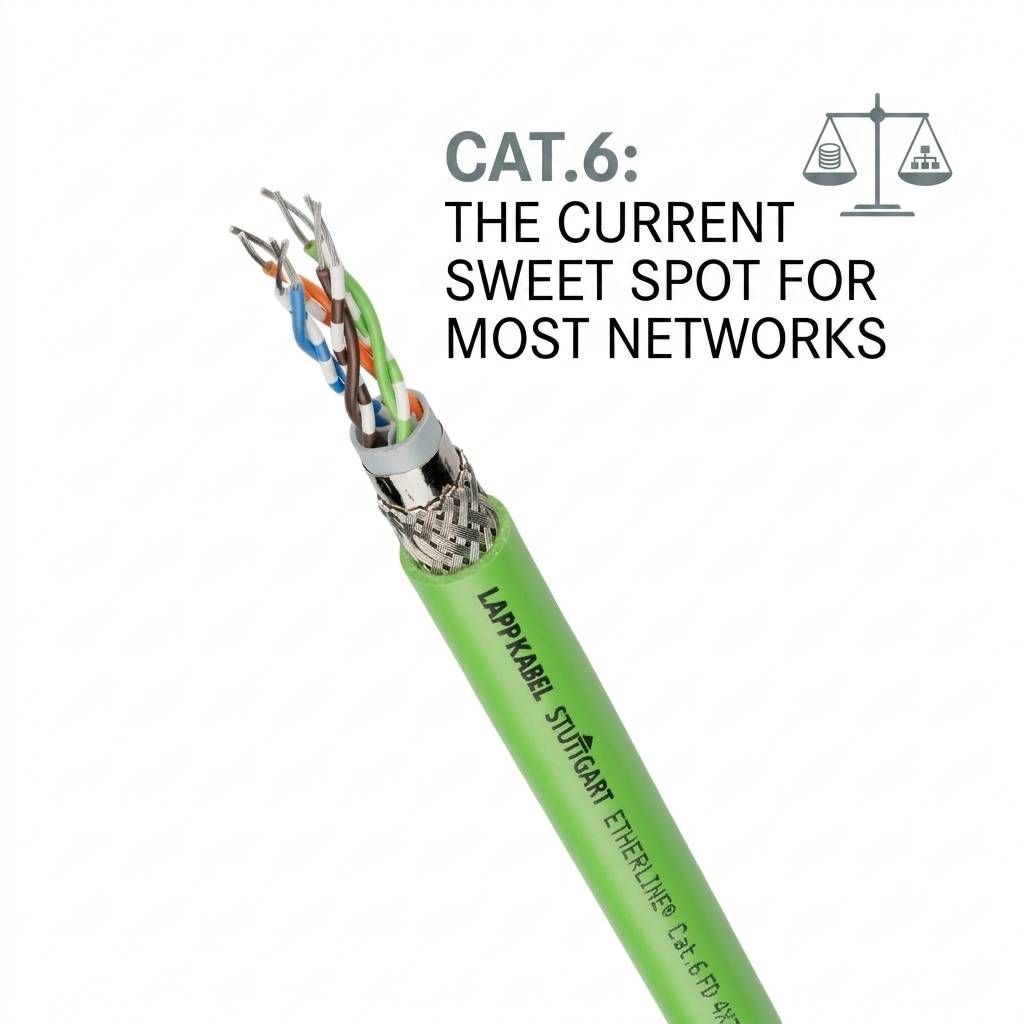
Cat6 doubles Cat5e’s bandwidth to 250 MHz and tightens crosstalk tolerances considerably. It typically uses a slightly thicker 23 AWG conductor and often includes a center spline that physically separates the four pairs to further reduce interference. Like Cat5e, it comfortably handles Gigabit Ethernet across the full 100-meter channel.
The detail many buyers miss is what happens at 10 Gbps. Cat6 can support 10GBASE-T, but only over a shorter distance — generally in the range of 37 to 55 meters depending on the cable’s construction, the amount of electrical interference in the installation, and how it’s bundled with other cables. Beyond that distance, the link either drops to Gigabit speeds or becomes unreliable. This makes Cat6 an excellent choice for most home and office networks today, but a cable to think twice about if your run length will exceed roughly 40–50 meters and you want guaranteed 10-gigabit performance.
For installations that mix office networking with PROFINET, EtherNet/IP, or other automation protocols, Eleczo’s LAPP ETHERLINE Cat.6 cable is built with a PUR outer jacket and tin-plated copper braiding, giving it better abrasion and chemical resistance than a typical consumer patch cable — useful if the cable run passes anywhere near a factory floor, panel, or outdoor conduit.
Cat6a: The Standard for Full-Length 10-Gigabit Performance
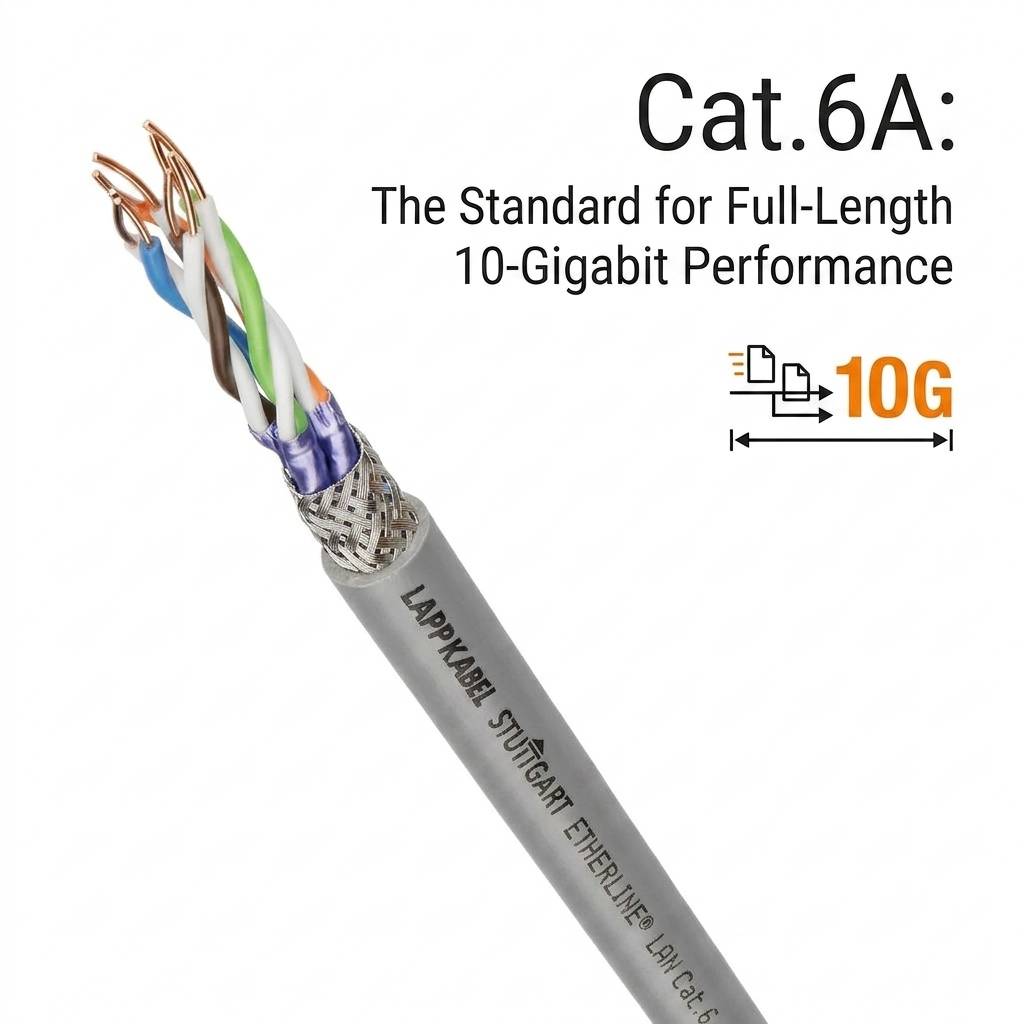
Cat6a (“augmented Cat6”) doubles the bandwidth again, to 500 MHz, and is the category specifically engineered to carry 10GBASE-T across the full 100-meter channel — patch cords included. It achieves this through tighter manufacturing tolerances, better-controlled “alien crosstalk” (interference from neighboring cables in the same bundle, not just between pairs in the same cable), and, in many constructions, individual foil shielding around each pair plus an overall braided shield (often labeled F/UTP or S/FTP).
Because it is fully standardized by both TIA and ISO/IEC, uses the same RJ45 connector as every other category, and costs only modestly more than Cat6, Cat6a has become the default recommendation for new structured cabling installs — particularly in data centers, commercial buildings, and any environment where 2.5/5/10-gigabit switches and routers are likely to be deployed within the cable’s service life. It also has more headroom for Power over Ethernet (PoE++) applications, where higher current can generate heat inside a bundled cable run.
Eleczo carries LAPP ETHERLINE Cat.6A cable with shielded PUR or halogen-free FRNC jacket options, designed for both fixed installation and continuous-flex applications such as robotics and machine-vision systems. If you are future-proofing an office, server room, or automation network and you’re unsure whether to choose Cat6 or Cat6a, Cat6a is generally the safer long-term investment.
Cat7: High Shielding, but Not TIA-Recognized
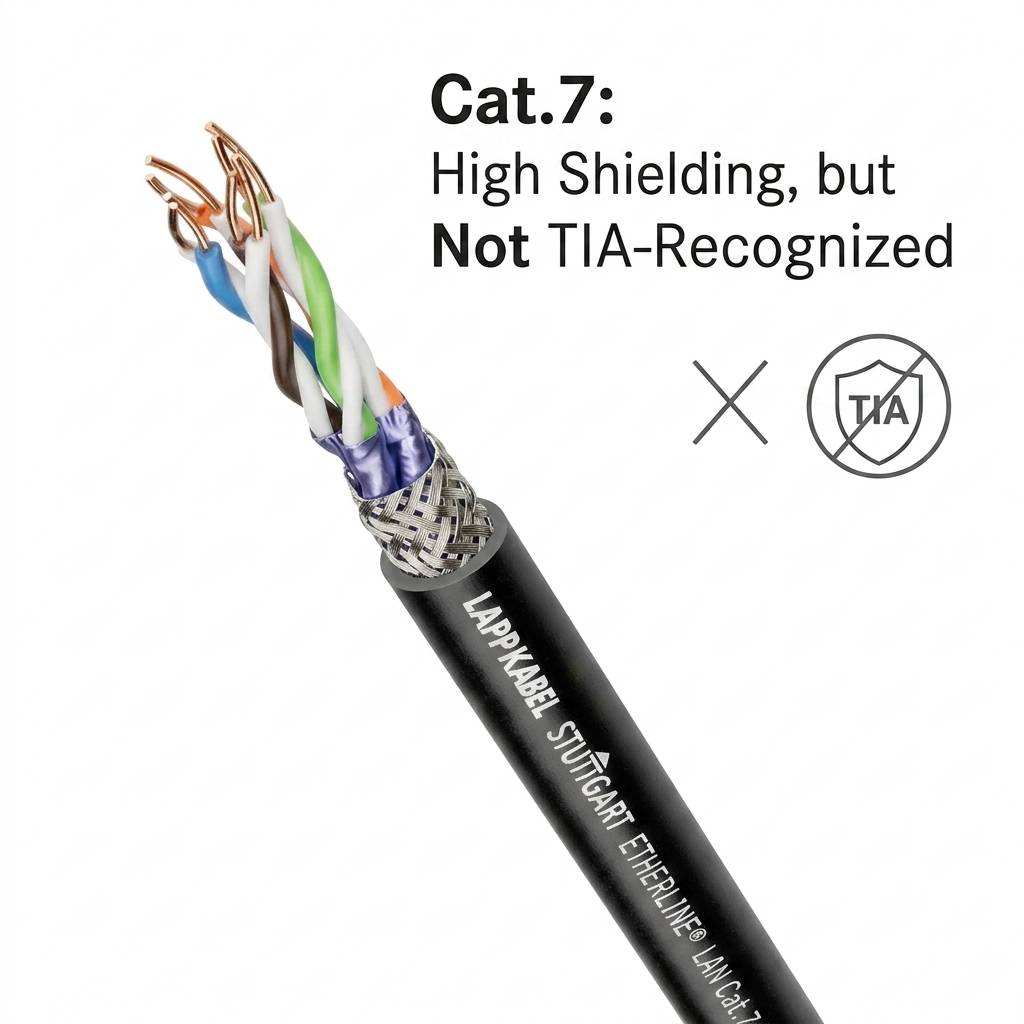
Cat7 (ISO/IEC Class F) is rated to 600 MHz and uses individually shielded pairs plus an overall shield (S/FTP), giving it excellent resistance to electromagnetic interference. On paper, that makes it sound like the obvious upgrade over Cat6a. In practice, Cat7 comes with a significant caveat that’s worth understanding before you buy it.
TIA never adopted Cat7 as part of the ANSI/TIA-568 standard — only ISO/IEC recognizes it. To achieve its full 600 MHz performance, the Cat7 specification calls for GG45 or TERA connectors rather than the standard RJ45 plug, because RJ45’s pin layout cannot fully suppress crosstalk at those frequencies. GG45 and TERA connectors, however, never gained meaningful adoption in networking hardware. As a result, the overwhelming majority of “Cat7” cables sold today are terminated with ordinary RJ45 connectors — which means the link is electrically limited to roughly Cat6a performance regardless of what the cable jacket says. You get Cat7’s extra shielding and durability, but not its theoretical bandwidth advantage.
This is why most networking professionals treat Cat7 as a niche product: useful in heavily shielded industrial or PROFINET environments where the robust construction and shielding matter more than the connector limitation, but rarely the right choice for a typical 10-gigabit upgrade when Cat6a delivers the same practical throughput at a lower cost and with simpler, fully standardized connectors. Eleczo’s LAPP ETHERLINE Cat.7 FLEX cable is positioned for exactly this use case: continuous-flex industrial automation wiring where the extra shielding and PUR jacket toughness justify the category, rather than general office or home networking.
Cat5e vs Cat6 vs Cat6a vs Cat7: Side-by-Side Comparison
Category | Max Frequency | Standard Body | Max Speed (100 m) | 10G Distance Limit | Best Suited For |
|---|---|---|---|---|---|
100 MHz | ANSI/TIA-568 | 1 Gbps | Not certified for 10G | Home networks, standard office drops | |
250 MHz | ANSI/TIA-568 | 1 Gbps (10G short runs) | ~37–55 m | Most homes/offices, short 10G runs | |
500 MHz | ANSI/TIA-568 & ISO/IEC | 10 Gbps | 100 m | New installs, data centers, PoE++ | |
600 MHz | ISO/IEC only | ~10 Gbps (Cat6a-level w/ RJ45) | 100 m (GG45/TERA only) | Shielded industrial/EMI-heavy environments |
How to Choose the Right Ethernet Cable Category
A few practical questions will narrow the decision quickly. First, consider the network speed you actually need, both today and over the cable’s realistic service life — structured cabling is rarely replaced more often than once a decade, so it’s worth sizing the cable for where your equipment is headed, not just where it is now. Second, measure your actual run length, since Cat6’s 10-gigabit ceiling depends heavily on distance, while Cat6a removes that constraint entirely. Third, evaluate the installation environment: cable routed near motors, variable frequency drives, fluorescent ballasts, or heavy machinery benefits substantially from shielded constructions, which is where industrial-grade ETHERLINE cables tend to outperform consumer-grade patch cables of the same category. Finally, factor in Power over Ethernet requirements; high-wattage PoE++ devices generate more heat inside a cable bundle, and thicker, higher-category conductors handle that better than thin Cat5e wiring.
If you only need reliable Gigabit speeds on a budget, Cat5e remains a perfectly sound, cost-effective choice. If you want a comfortable buffer for 10-gigabit equipment on short-to-medium runs without paying for Cat6a, Cat6 is the practical middle ground. If you’re wiring anything new — an office, a data center, an automation network, or any installation you don’t want to redo in five years — Cat6a is the standards-backed, future-proof default. Cat7 is worth its premium only when the shielding and ruggedness are specifically needed, such as alongside industrial power cabling.
Common Misconceptions About Ethernet Cable Categories
“Cat6e” is a real, certified category. It is not. There is no Cat6e in the ANSI/TIA-568 or ISO/IEC 11801 standards; it’s a marketing term some manufacturers use for enhanced Cat6 cable, and any certified field test will only ever validate it as Cat6 or Cat6a.
Cat6 supports 10 Gbps over the full 100 meters, just like Cat6a. It doesn’t. Cat6’s 10GBASE-T support is distance-limited to roughly 37–55 meters; only Cat6a is rated for the full 100-meter channel at 10 Gbps.
A Cat7 cable automatically outperforms Cat6a. Only if it’s terminated with GG45 or TERA connectors, which almost none are. With standard RJ45 connectors, a Cat7 cable’s electrical performance is effectively capped at Cat6a levels.
Higher category is always better. Not necessarily for your situation. Beyond a certain point, you’re paying for shielding, bandwidth, and distance headroom your network hardware and cable run will never use. Matching the category to your actual speed, distance, and environment avoids unnecessary cost.
Final Thoughts
Choosing between Cat5e, Cat6, Cat6a, and Cat7 ultimately comes down to matching bandwidth, distance, and shielding to your real-world network — not chasing the highest number on the box. For most homes and offices, Cat6 or Cat6a will cover current and near-future needs comfortably, while Cat5e remains a sound option for straightforward Gigabit connections on a budget. Cat7 has its place, but mainly in shielded industrial settings where its non-standard status is less of a drawback.
Whatever category fits your project, buying genuine, standards-compliant cable matters as much as the category itself — a cable that doesn’t meet its rated specification will underperform regardless of what’s printed on the jacket. You can compare LAPP ETHERLINE Cat5e, Cat6, Cat6A, and Cat7 cables, along with connectors and accessories, on Eleczo’s network and signal cables page.
Frequently Asked Questions
Is Cat6a backward compatible with Cat6 and Cat5e?
Yes. All categories within the ANSI/TIA-568 family use the same RJ45 connector and are backward compatible, so you can mix categories in a network, though the overall link will only perform at the level of its weakest segment.
Do I need shielded cable for a home network?
Usually not. Unshielded twisted pair (UTP) is sufficient for most homes. Shielded variants (F/UTP, S/FTP) become worthwhile near elevators, large appliances, industrial equipment, or dense cable bundles where electromagnetic interference is a real concern.
Will a higher-category cable make my internet faster than my ISP plan allows?
No. Cable category only affects the maximum speed the wiring can carry between your devices; it cannot exceed the speed delivered by your internet service or the capability of your router, modem, and network adapters.
Can I use Cat6a cable for industrial automation protocols like PROFINET or EtherCAT?
Yes, provided you use an industrial-rated cable designed for the application — fixed installation, continuous flex, or high-temperature, as needed — rather than a standard office patch cable, since automation environments typically demand tougher jackets and shielding.