Ethernet Cable Shielding Types Explained for Networks

If you've ever had a network connection that drops intermittently near a motor, an elevator shaft, or a bank of fluorescent lights, the cable itself is usually the first thing people blame — and sometimes they're right. The fix often comes down to one spec that gets skipped over on most purchase orders: ethernet cable shielding.
Shielding isn't a single thing. It's a family of constructions — foil, braid, or a combination of both — and each one protects your data differently. Picking the wrong one (or skipping it where it's genuinely needed) is a common reason cabling projects underperform even when the category rating, Cat5e, Cat6, Cat6A, looks correct on paper.
This guide breaks down how shielding actually works, what foil shielding, braided shielding, and foil+braid construction each do well, how to read the confusing codes printed on a cable jacket, and how to decide — honestly, without overselling it — whether your next network run actually needs a shielded cable at all.
Quick takeaways
Foil shielding wraps the pairs in a continuous metal layer with full coverage — strong against high-frequency noise, but it has a short flex life.
Braided shielding uses a woven copper mesh that's tougher and better against low-frequency interference (motors, drives), but it never covers 100% of the surface.
Foil+braid (commonly sold as S/FTP) combines both, giving the widest protection — it's what most Cat7, Cat6A-industrial, and Cat8 cables use.
A shielded cable that isn't properly grounded gives you none of these benefits — and can occasionally perform worse than a plain unshielded cable.
Most home and standard office networks run perfectly well on unshielded twisted pair. Shielding earns its cost in specific, identifiable environments.
What Is Ethernet Cable Shielding, and Why Does It Exist?
Every standard network cable is built from four pairs of copper wires, twisted together. That twist isn't decorative — it's the cable's first line of defense against interference, because twisting the wires causes electrical noise picked up by one wire in a pair to be largely cancelled out by the noise picked up by its twisted partner. This is how basic unshielded twisted pair (UTP) cable, like everyday Cat5e or Cat6, gets away with no metal shield at all in the vast majority of installations.
What twisting can't fully solve is noise coming from outside the cable: motors, variable-frequency drives, fluorescent or HID lighting ballasts, large transformers, nearby power cables, or even "alien crosstalk" leaking in from other data cables packed tightly into the same bundle or conduit. That's the gap ethernet cable shielding is built to close. A metal layer — foil, braid, or both — is added around the individual pairs and/or the whole cable, and that metal layer is meant to intercept stray electromagnetic energy and carry it away to ground before it ever reaches the copper conductors carrying your data.
How to Read Shielding Codes on a Cable Jacket
The international cabling standard ISO/IEC 11801 (Annex E) defines a two-part naming system that takes the guesswork out of shielding specs. It looks like this: [overall shield] / [individual pair shield] TP.
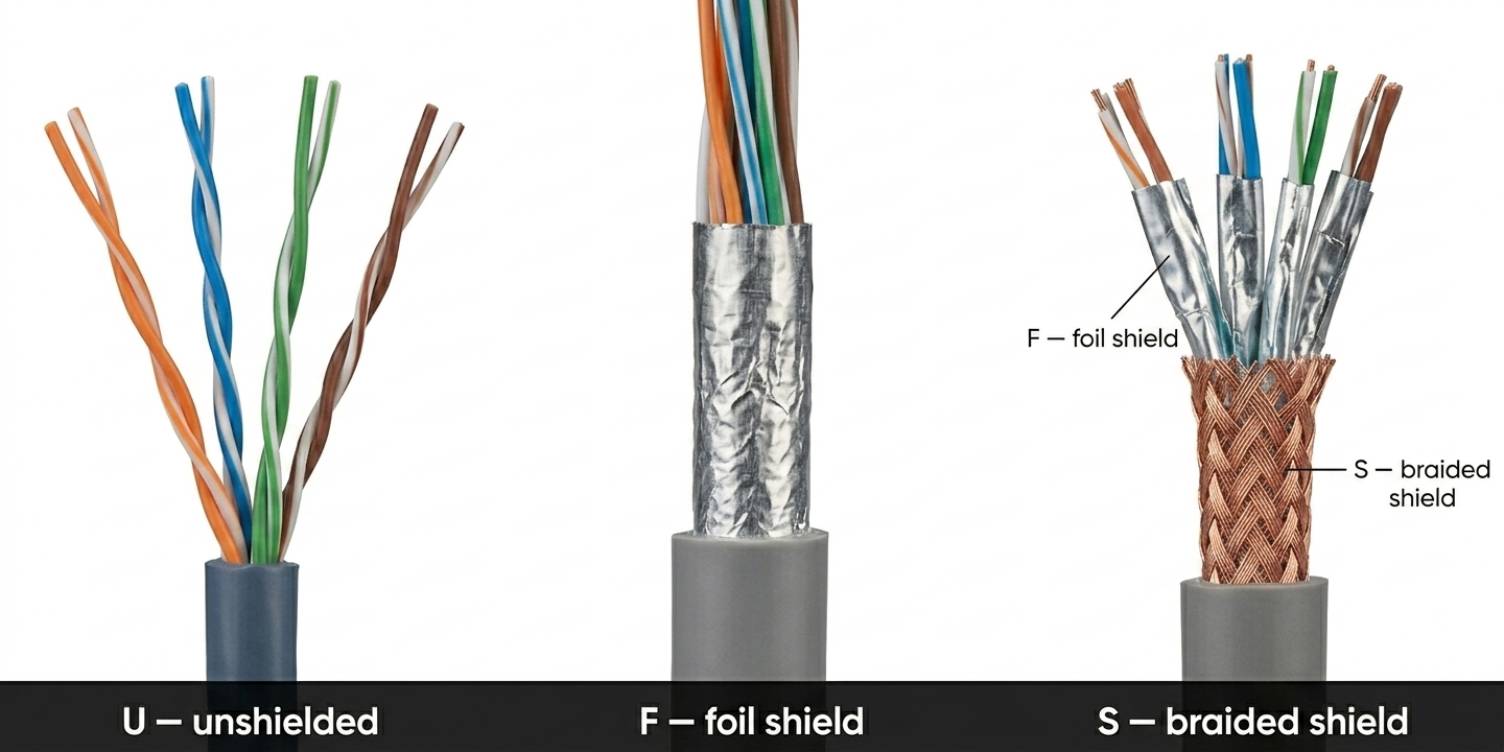
U = unshielded
F = foil shield
S = braided shield (sometimes both letters appear together, as in SF)
The letter(s) before the slash describe the shield around all four pairs together, under the outer jacket. The letter(s) after the slash describe whether each individual pair also has its own shield.
Code | Overall shield | Per-pair shield | Common name |
|---|---|---|---|
U/UTP | None | None | Standard UTP |
F/UTP | Foil | None | Often called "FTP" |
U/FTP | None | Foil | — |
S/FTP | Braid | Foil | Often loosely called "STP" |
SF/UTP | Braid + foil | None | Also sometimes called "STP" |
S/STP, F/FTP, SF/FTP | Braid and/or foil | Braid and/or foil | Used in Cat7/Cat7A/Cat8 |
Here's where a lot of confusion (and a fair number of mis-ordered cables) comes from: "STP" doesn't have one fixed meaning in practice. Strictly, under ISO/IEC 11801, STP means U/STP — a braided shield around each pair with no overall shield at all, a construction that's almost never actually manufactured. In real-world catalogs and even on some packaging, "STP" gets used loosely to mean almost any shielded cable — F/UTP, S/FTP, or SF/UTP. If the shielding type genuinely matters for your project, look past the marketing name and check the two-part code on the datasheet or jacket print.
The Three Main Types of Ethernet Cable Shielding
Foil Shielding
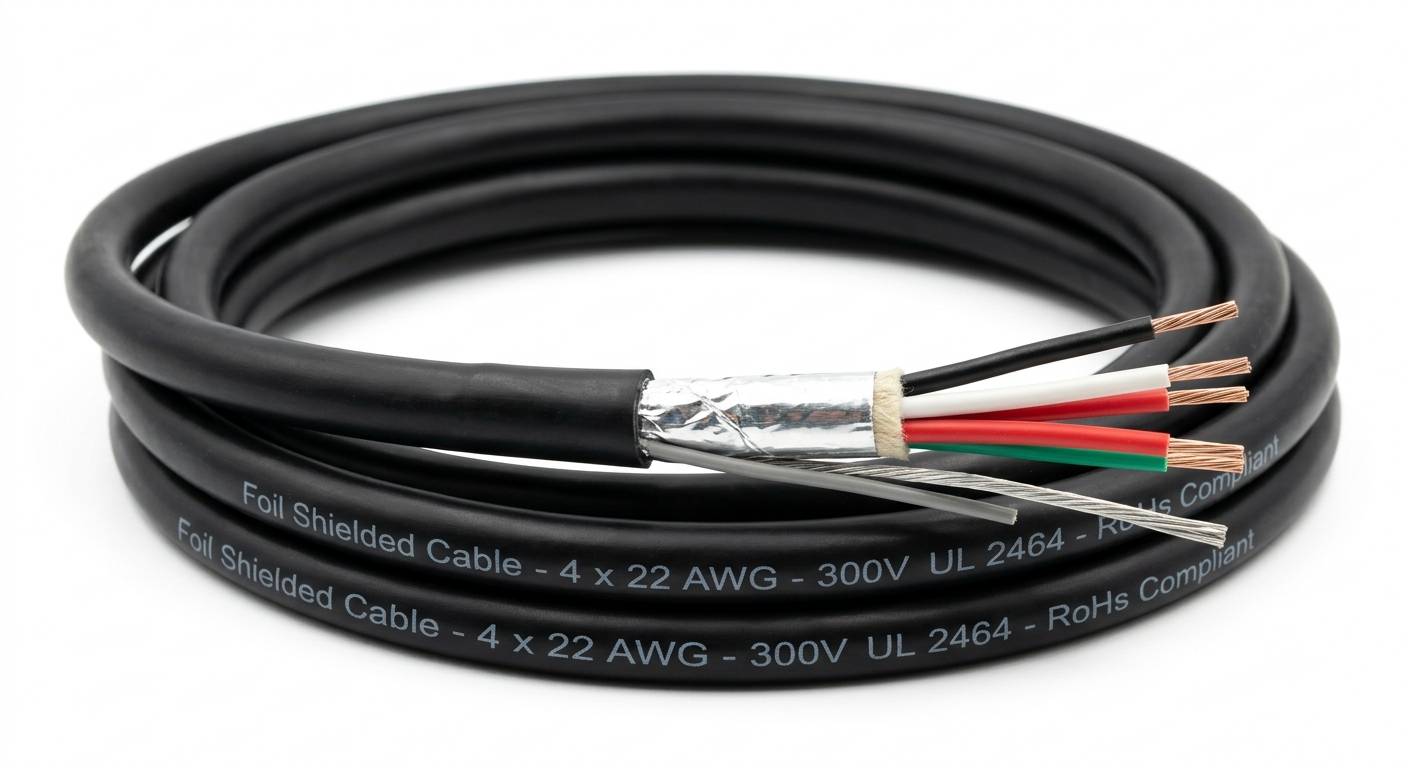
Foil shielding is a thin layer of aluminum (often laminated to a polyester or Mylar film) wrapped continuously around the pairs or the whole cable. Because it's a solid wrap rather than a weave, it provides close to 100% coverage with no gaps — which makes it genuinely effective against high-frequency electromagnetic and radio-frequency interference, the kind that becomes more relevant as you move into Cat6A and 10GBASE-T speeds.
Foil's other advantage is practical: it's thin and light, so it adds very little bulk or stiffness to the cable. The trade-off is durability. Foil is fragile and has a noticeably shorter flex life than braid — repeated bending or pulling can crack the layer and create gaps in coverage over time. Foil-shielded cable also needs a small drain wire running in contact with the foil so it can actually be terminated and grounded at the connector. You'll most often find foil shielding in F/UTP-style Cat6 and Cat6A cable used for fixed runs — in-wall, under-floor, or in conduit — where the cable is installed once and not regularly flexed afterward.
Braided Shielding
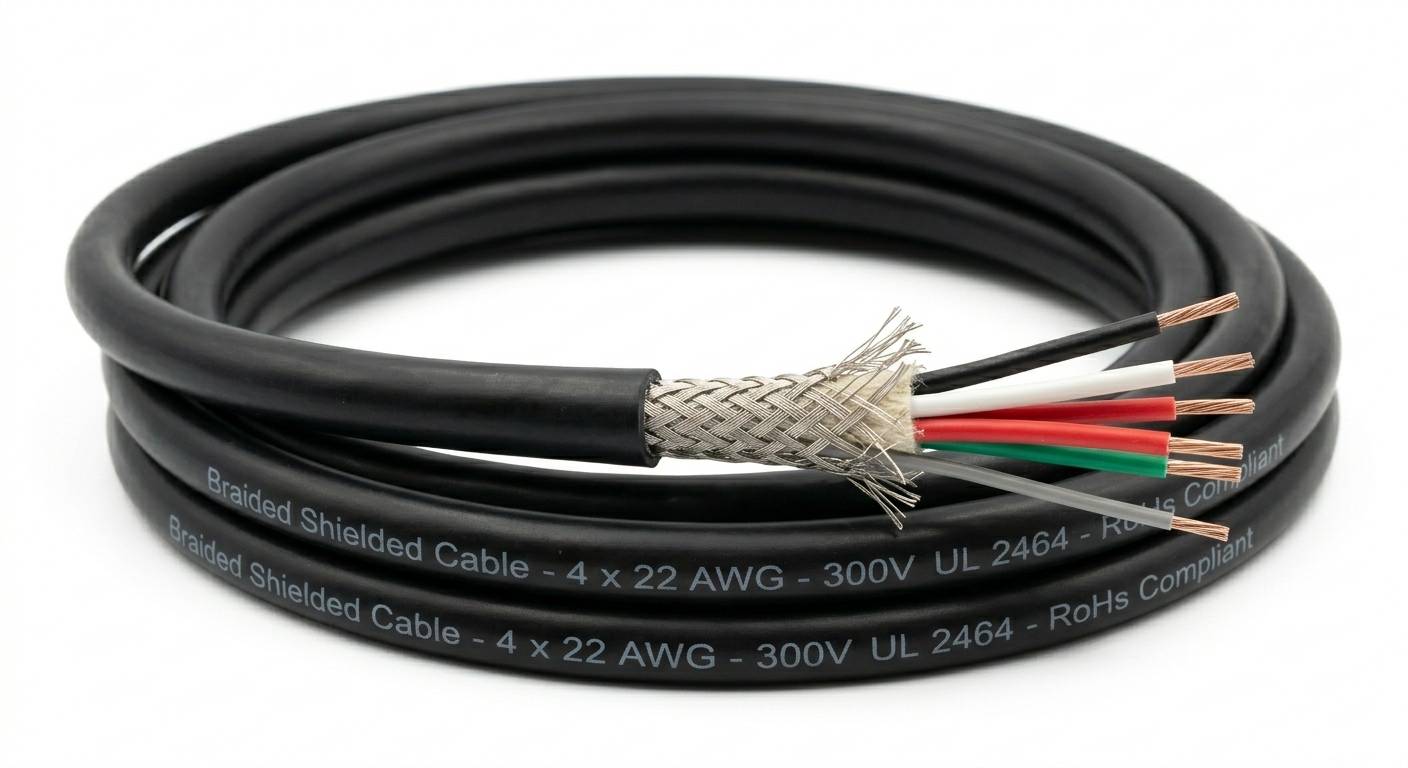
Braided shielding is a woven mesh of fine copper strands (often bare or tin-plated) forming a sleeve around the cable, similar to a tight metal sock. Because it's woven rather than a continuous sheet, coverage is never complete — typically 70% to 95%, depending on how tightly it's braided.
What braid gives up in total coverage, it makes up for in two areas: low-frequency performance and physical toughness. Braided shielding is particularly effective against the kind of interference generated by motors, transformers, and variable-frequency drives — common sources of electrical noise on a factory floor. It also tolerates tens of thousands of flex cycles, adds real mechanical strength, and resists crushing far better than foil. The cost is size, weight, and price: braided cable is bulkier, heavier, and more expensive to manufacture than its foil-only equivalent, and very dense braids can make the cable noticeably stiffer to route. This is why braided constructions show up so often in industrial automation cabling — including PROFINET and EtherNet/IP runs on plant floors, where the cable gets pulled through cable trays, flexed at machine joints, and lives permanently near electrically noisy equipment.
Foil + Braid (Combination Shielding)
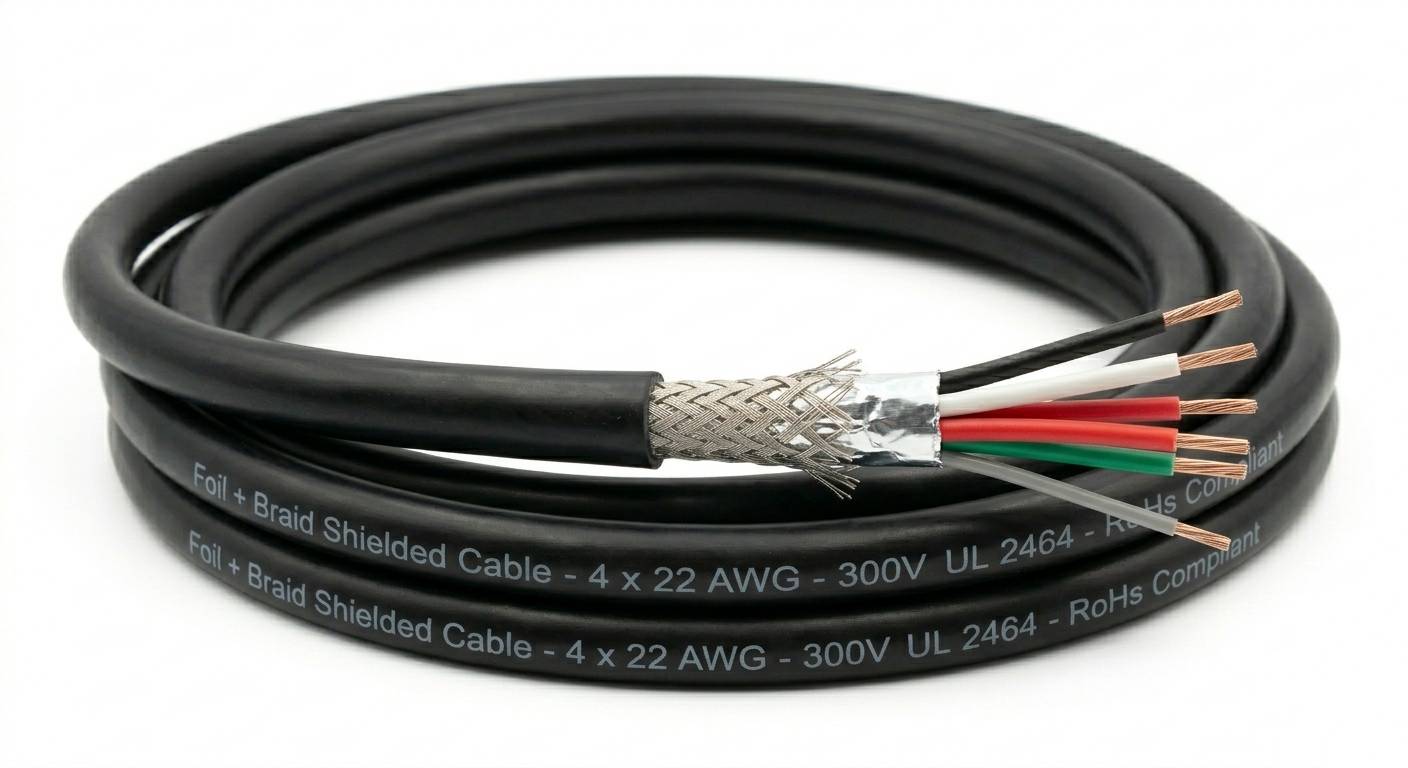
Combination shielding — sold under codes like S/FTP, SF/UTP, F/FTP, or SF/FTP — layers a foil shield with a braided shield, usually foil around each pair plus an overall braid (or vice versa). The result covers the widest practical frequency range: foil's near-complete coverage handles high-frequency noise, while the braid adds low-frequency performance and the mechanical durability that foil alone lacks.
This is exactly why ISO/IEC 11801 specifies foil+braid (S/FTP or F/FTP) as the minimum construction for Cat7 and Cat7A, and why it's the standard choice for Cat8 and for Cat6A deployments running through dense, high-interference environments — data center cross-connects, server room backbones, and industrial control rooms where automation wiring and IT cabling share the same space. The trade-off is straightforward: foil+braid cable costs the most, has the largest diameter, and is the least flexible of the three options, with a stricter minimum bend radius. It's also more involved to terminate correctly, since there are two shield layers that both need a clean, grounded connection rather than just one.
Foil vs Braided vs Foil+Braid: Quick Comparison
Foil Shielding | Braided Shielding | Foil + Braid | |
|---|---|---|---|
Coverage | Near 100%, continuous | 70–95%, woven gaps | Near-complete, two layers |
Best against | High-frequency EMI/RFI | Low-frequency EMI (motors, drives) | Full frequency range |
Flex life / durability | Lower — can crack with repeated flexing | High — tens of thousands of flex cycles | High, but bulkier and stiffer |
Relative cost | Lowest | Medium-to-high | Highest |
Typical use | Fixed Cat6/Cat6A office and IT runs | Industrial automation, factory-floor cabling | Cat7/Cat7A/Cat8, data centers, mixed IT-and-industrial environments |
Do You Actually Need Shielded Ethernet Cable?
This is the question worth answering honestly before you spend more on shielded cable, shielded connectors, and the grounding hardware that goes with them.
Standard unshielded twisted pair (Cat5e or Cat6) remains the right, cost-effective default for the overwhelming majority of home and office networks. It's easier to install, terminates faster, has a smaller bend radius, and doesn't need to be grounded — and in a typical office with no heavy machinery nearby, it performs identically to a shielded equivalent.
Shielded cable earns its place in more specific situations:
The run passes near motors, lift shafts, large transformers, welding equipment, or VFD-driven machinery — common in factories, warehouses, and workshops.
You're cabling a data center, server room, or comms room with hundreds of cables bundled tightly together, where alien crosstalk between adjacent cables becomes measurable at 10G speeds.
You're deploying Cat6A, Cat7, or Cat8 for a 10Gbps-plus backbone or cross-connect, where the relevant standard increasingly calls for a shielded construction by default.
The cable runs outdoors, through an electrically noisy underground duct, or alongside high-voltage power cabling.
You're running high-power PoE++ (60W or 90W), where the metal shield's heat-dissipation effect is a genuine secondary benefit.
If none of these apply to your project, a quality unshielded cable at the right category rating is very likely the more practical choice — paying for shielding without a real EMI source to protect against adds installation complexity without a measurable performance gain.
The Mistake Installers Make Most: Forgetting to Ground the Shield
A shield — foil, braid, or both — only does its job if it's actually bonded to ground, typically at one end of the link, through a shielded connector, keystone jack, or patch panel that makes solid metal-to-metal contact with the cable's shield layer. An ungrounded shielded cable doesn't just fail to help; left floating, the shield can act like an antenna and, in some cases, make interference slightly worse than a plain unshielded cable would.
In practice, this means shielding is a system decision, not just a cable decision. If you specify shielded cable, every connector, jack, and patch panel in that link needs to be a shielded version too, and the rack or enclosure needs a proper earth bonding point. A surprising number of "underperforming shielded installations" turn out to be a shielded cable terminated into an unshielded plug — which quietly throws away the entire benefit you paid for.
Choosing the Right Shielded Cable for Your Network
Category rating and shielding type are two separate decisions that work together. The category (Cat5e, Cat6, Cat6A, Cat7, Cat8) sets your bandwidth and supported speed; the shield type sets how well that signal holds up against outside interference.
For a typical office upgrade or 10G-ready backbone, an F/UTP or S/FTP Cat6/Cat6A cable strikes a reasonable balance between cost and future headroom. For factory-floor automation networks — PROFINET, EtherNet/IP, or EtherCAT lines running near motors and drives — a braided or foil+braid industrial Ethernet cable rated to the category your equipment needs is the standard, proven choice; this is exactly the construction used in industrial-grade cable like the Siemens Industrial Ethernet FC TP cable available on Eleczo for PROFINET applications.
If you're building out structured cabling near electrical risers, lift machinery rooms, or any space with a documented EMI source, LAPP's Etherline range — stocked on Eleczo across Cat6, Cat6 FD, and Cat7 FLEX constructions with tin-plated copper braiding — is a genuine, brand-authorized option with the datasheets to back the specification, plus GST-compliant invoicing and bulk-order pricing for contractors and system integrators.
Whichever cable you choose, remember the grounding point above: pair it with matching RJ45/RJ11 connectors, telephone-and-ethernet information sockets, and surface mount boxes from Eleczo's networking and signal cable accessories range, so the shielding stays intact at every termination, not just along the run.
Recommended Ethernet Cables Available on Eleczo
When purchasing Ethernet cables, prioritize:
Genuine branded products
Certified Cat6 or Cat6A performance
Proper shielding specifications
Quality conductors
Reliable connectors
At Eleczo, buyers can find Ethernet networking solutions suitable for residential, commercial, and industrial applications. When selecting a cable, review the shielding type, category rating, installation environment, and bandwidth requirements to ensure long-term performance.
For industrial environments with significant electrical interference, consider shielded Cat6 or Cat6A cables featuring foil shielding, braided shielding, or foil+braid shielding based on the level of protection required.
Explore Ethernet Cable Categories at Eleczo
Final Thoughts
Choosing between foil, braided, and foil+braid ethernet cable shielding isn't about finding the universally "best" option — it's about matching the shield to the electromagnetic environment the cable will actually live in, the category rating your network needs, and a realistic budget. A straightforward unshielded Cat6 cable is the right call for most office and home networks. A braided or foil+braid shielded cable earns its cost on a factory floor next to a bank of variable-frequency drives, or in a data center backbone running 10G across hundreds of bundled cables.
Eleczo stocks genuine, brand-authorized Etherline and industrial Ethernet cable across unshielded, foil, braided, and foil+braid constructions, with full datasheets, so you can specify exactly what your installation calls for rather than guessing — and back it up with the matching connectors and accessories needed to keep that protection intact end to end.
Frequently Asked Questions
What does "shielded" actually mean on an Ethernet cable?
It means the cable has one or more metal layers — foil, braid, or both — wrapped around the twisted pairs, the whole cable, or both, specifically to block outside electrical noise from reaching the copper conductors. This is on top of the noise cancellation the twisting itself already provides between pairs.
Is shielded Ethernet cable faster than unshielded?
No. Speed and bandwidth come from the cable's category (Cat5e, Cat6, Cat6A, and so on), not from shielding. An unshielded Cat6A cable will outperform a shielded Cat5e cable every time. Shielding affects signal integrity in electrically noisy environments — it doesn't raise a cable's maximum supported speed.
What's the real difference between FTP and STP?
FTP, more precisely written F/UTP, uses a foil layer wrapped around all four pairs together with no individual pair shielding. "STP" is used loosely across the market to mean almost any shielded cable, but its strict ISO/IEC 11801 meaning — a braided shield around each individual pair with no overall shield — is rarely manufactured in practice. What most people actually mean, and usually want, is S/FTP (foil per pair plus an overall braid) or F/UTP. Always check the printed two-part code rather than relying on the word "STP" alone.
Do I need shielded cable for a home network?
Almost never. Home installations are rarely near the kind of heavy electrical equipment that shielding is designed to protect against, so a quality unshielded Cat6 cable is the practical, cost-effective choice for nearly all home and small-office networks.
Can I connect a shielded cable to unshielded connectors or jacks?
You can physically do it, but you lose most of the benefit. The shield needs a continuous, grounded metal path through every connector and jack in the link to actually carry interference away. Mixing shielded cable with unshielded terminations is one of the most common reasons a "shielded" installation doesn't perform any better than standard UTP.
Does shielding reduce the maximum Ethernet cable run length?
No, not directly. The 100-meter channel limit for twisted-pair Ethernet comes from the TIA/EIA-568 and ISO/IEC 11801 standards regardless of shielding. What shielding changes is how clean the signal stays within that distance when the surrounding environment is electrically noisy.