Understanding Ethernet/IP Networks in Industrial Systems

Ethernet/IP has become the backbone of modern industrial communication — powering factories, process plants, and smart manufacturing facilities worldwide. This guide explains exactly how it works, what cabling you need (Cat5e, Cat6, Cat6a, Cat7), and how to choose the right components for your operation.
1. What Is Ethernet/IP? The Basics Explained
Ethernet/IP — where "IP" stands for Industrial Protocol, not "Internet Protocol" — is an open industrial communication standard that runs the Common Industrial Protocol (CIP™) over standard, unmodified Ethernet infrastructure. It was developed by Rockwell Automation and officially introduced in 2001, and today is managed by the Open DeviceNet Vendors Association (ODVA).
Think of it this way: the Ethernet cable on your office desk carries HTTP (web traffic) or SMTP (email). Those protocols work perfectly in offices, but lack the precision, speed, and determinism that a factory floor demands. Ethernet/IP adapts the same standard Ethernet infrastructure — the cabling, the switches, the TCP/IP stack — and layers CIP on top to meet the strict demands of industrial automation.
Key Fact: Ethernet/IP is an IEEE 802.3-compliant protocol that uses both TCP/IP (for reliable explicit messaging) and UDP/IP (for fast, real-time I/O messaging). This dual-transport approach is what gives it both reliability and speed on the factory floor. |
Why "Ethernet/IP" and Not Just "Ethernet"?
Standard office Ethernet was never designed for real-time machine control. Industrial environments require deterministic communication — meaning messages must arrive within guaranteed, predictable time windows. A PLC commanding a robotic arm cannot tolerate the random delays that standard office networking accepts. Ethernet/IP solves this by adding CIP's application layer on top of Ethernet, enabling real-time, reliable, and prioritized communication between devices on the factory floor.
2. How Ethernet/IP Works: Protocol Architecture
Ethernet/IP follows the OSI (Open Systems Interconnection) 7-layer model. The lower layers are standard Ethernet (physical cabling, MAC addressing, TCP/IP), while the upper layers are CIP — the industrial intelligence layer. Here is how the stack breaks down:
Layer | Name | Role in Ethernet/IP |
|---|---|---|
7 | Application (CIP) | CIP objects, I/O data, device profiles — industrial commands and data exchange |
6 | Presentation (CIP) | Data encoding and formatting for CIP messages |
5 | Session (CIP) | Session management, encapsulation of CIP over TCP/UDP |
4 | Transport (TCP/UDP) | TCP for explicit (config/diagnostic) messages; UDP for implicit (real-time I/O) messaging |
3 | Network (IP) | IP addressing, routing across subnets and plant-wide networks |
2 | Data Link (Ethernet) | MAC addressing, CSMA/CD, frame-level communication between devices |
1 | Physical (Cable) | Cat5e / Cat6 / Cat6a / Cat7 copper cable or fiber optic — the actual wire |
Two Types of Messaging: Explicit and Implicit
Explicit Messaging (TCP): Request-response communication used for configuration, diagnostics, and non-time-critical data exchange. A controller asks a device for a specific value, and the device replies. Uses TCP for guaranteed, ordered delivery.
Implicit Messaging (UDP): Cyclic, real-time I/O communication. Data is automatically sent at set intervals without a request. Used for continuous sensor readings, motion control, and time-sensitive machine data. Uses UDP for maximum speed.
Provider-Consumer Model: EtherNet/IP supports a provider-consumer network model, where one device (provider) sends data and multiple consumers can receive it simultaneously. This is far more bandwidth-efficient than traditional polling approaches and enables scalable plant-wide communication. |
3. Key Components of an Ethernet/IP Network
A typical industrial Ethernet/IP deployment integrates several hardware and software components working together:
PLC / Controller (Scanner): The master device (e.g., Allen-Bradley ControlLogix) that initiates connections and manages I/O data exchange across the network.
Field Devices (Adapters): Drives, sensors, actuators, and I/O modules that respond to the scanner. Any ODVA-certified device is interoperable regardless of manufacturer.
Managed Industrial Switches: Industrial-grade switches with IGMP snooping, QoS, and VLAN support ensure deterministic, prioritized data flow in plant environments.
Ethernet Cable (Physical Layer): The physical foundation: Cat5e, Cat6, Cat6a, or Cat7 copper cable — or fiber for longer runs. Cable quality directly impacts network reliability.
Routers / Gateways: Connect Ethernet/IP segments to enterprise IT networks, enabling IT/OT convergence for Industry 4.0 and IIoT initiatives.
Firewalls / Security Appliances: Protect the OT network from IT-side threats. Essential for any facility with plant-to-enterprise connectivity.
4. Industrial Applications of Ethernet/IP
Ethernet/IP's versatility has made it the preferred choice across a wide range of industrial sectors. It supports control, safety, energy management, motion, configuration, and real-time information exchange — all on a single unified network architecture.
PLC-to-drive communication, robotic arm control, conveyor management, and assembly line coordination in discrete manufacturing Manufacturing Automation:
Control and regulation of fluids, gases, and chemicals using valves, flow meters, and process controllers Process Industries:
Coordinating multi-axis motion control, welding robots, and stamping press automation Automotive & Heavy Industry:
Hygiene-critical environments where sealed IP67-rated Ethernet/IP devices maintain network connectivity despite washdowns Food & Beverage Processing:
Remote monitoring and SCADA integration over Ethernet/IP with fiber for long-distance runs Oil & Gas / Utilities:
IIoT integration, Industry 4.0 data collection, and IT/OT network convergence Building Automation & Smart Factories:
CIP Safety, an extension of CIP, runs over EtherNet/IP to eliminate separate wiring for safety-critical functions like emergency stops Safety Systems:
5. Ethernet Cables for Industrial Networks: Cat5e, Cat6, Cat6a & Cat7
The physical layer of any Ethernet/IP network is only as strong as the cable running through it. ODVA's own technical documentation recommends Cat5e or later for industrial manufacturing applications, citing greater noise immunity and safeguards against harsh environments. Understanding the differences between cable categories is essential for designing a reliable, future-proof industrial network.
Why Cable Choice Matters in Industrial Settings: Factory floors generate significant electromagnetic interference (EMI) from motors, welding equipment, and high-power drives. The wrong cable can cause data corruption, network dropouts, and costly downtime. Choosing the right category — and shielding type — is a critical engineering decision, not just a procurement one. |
Cat5e — The Baseline That Still Delivers
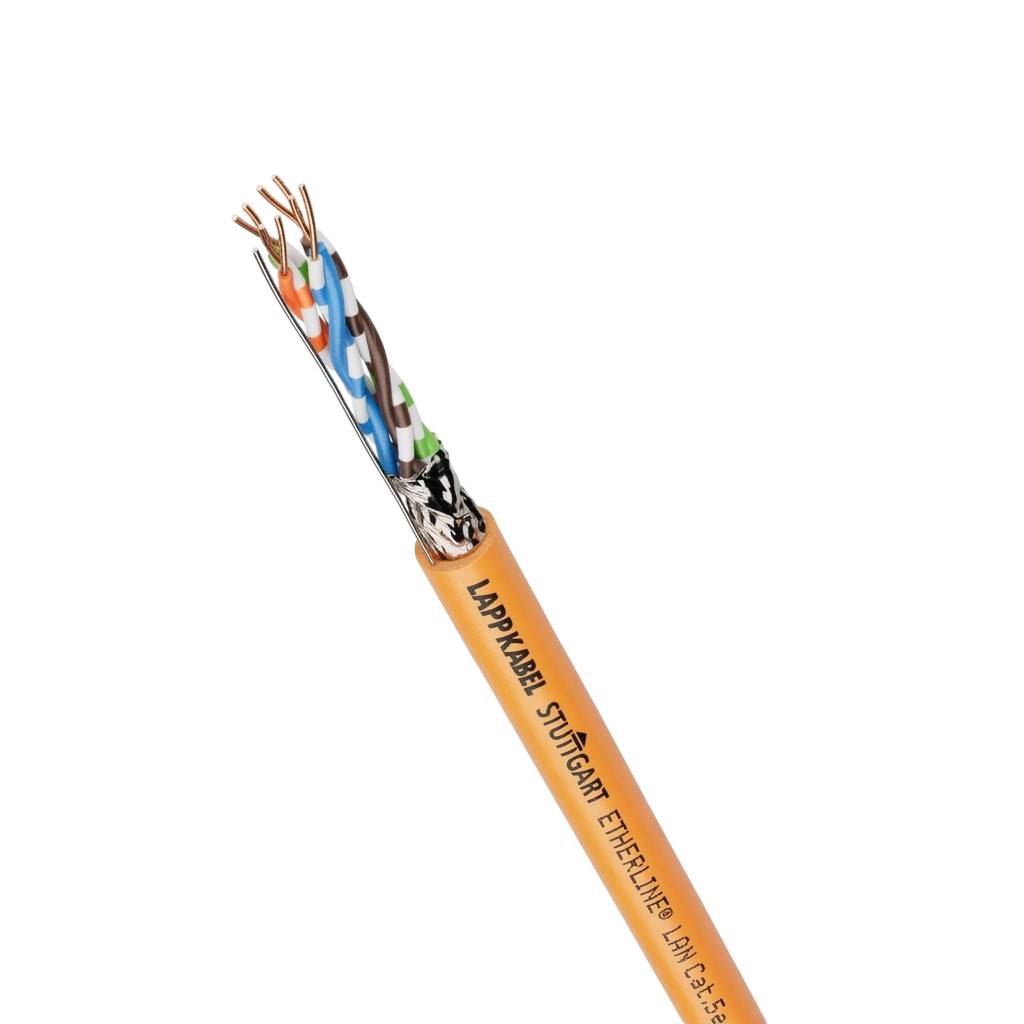
Cat5e (Category 5 Enhanced) is the minimum recommended standard for Ethernet/IP networks. It supports Gigabit Ethernet (1000BASE-T) across the full 100-meter run and provides a noticeable improvement over older Cat5 in noise rejection. For small-to-medium Ethernet/IP deployments where data rates are modest and EMI levels are manageable, Cat5e remains a cost-effective option — particularly for retrofitting existing cable infrastructure.
In environments with significant electrical noise (near variable frequency drives, motors, or high-power switchgear), Cat5e's unshielded construction may prove insufficient. In these cases, opting for shielded Cat5e (F/UTP) or upgrading to Cat6 is advisable.
Cat6 — The Industrial Sweet Spot
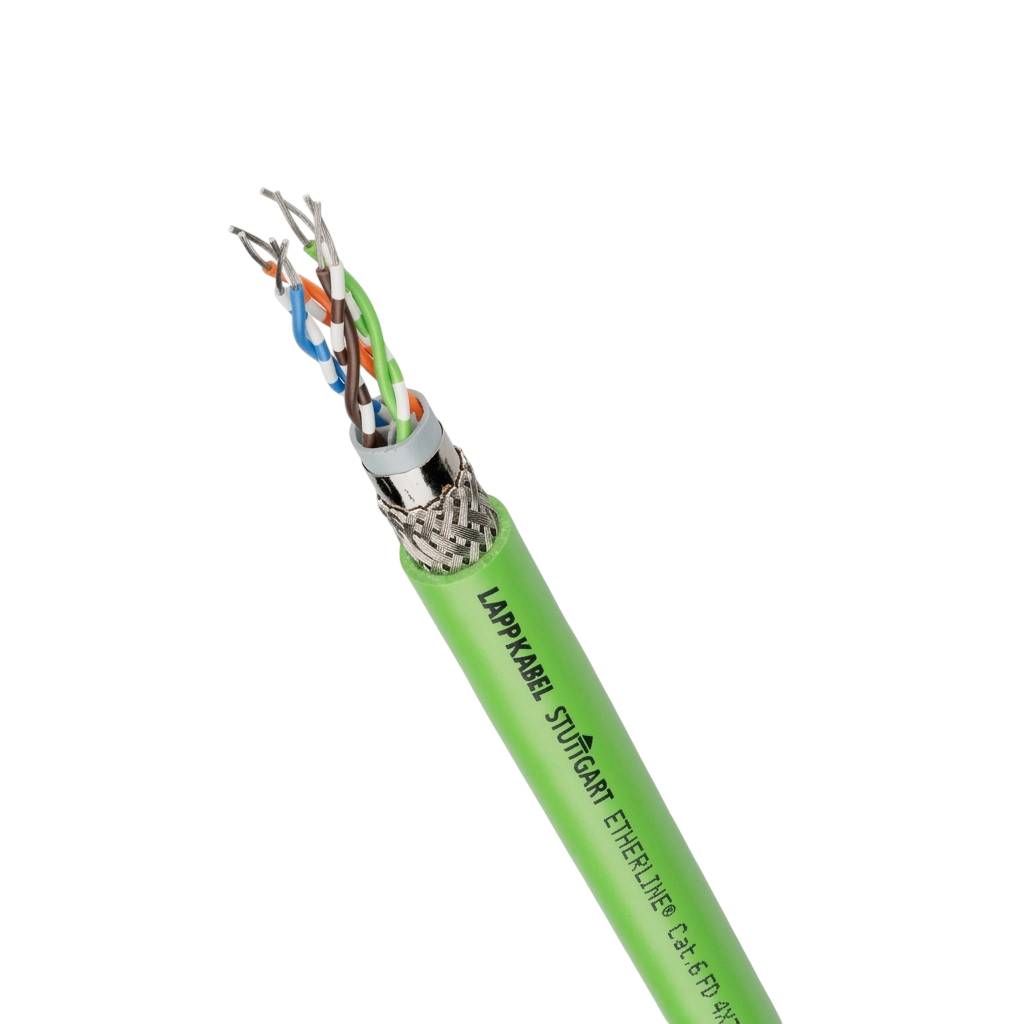
Cat6 (Category 6) features tighter wire twists, a thicker gauge, and a plastic spline that physically separates the four wire pairs — significantly reducing crosstalk compared to Cat5e. It operates at up to 250 MHz and delivers 1 Gbps reliably across 100 meters, with 10 Gbps possible at shorter runs (up to 37–55 meters).
For most standard Ethernet/IP deployments in light-to-medium industrial environments, Cat6 strikes the right balance between performance and cost. Its improved signal-to-noise ratio makes it a durable choice for factory floors where moderate EMI is present.
Cat6a — The Future-Proof Industrial Standard
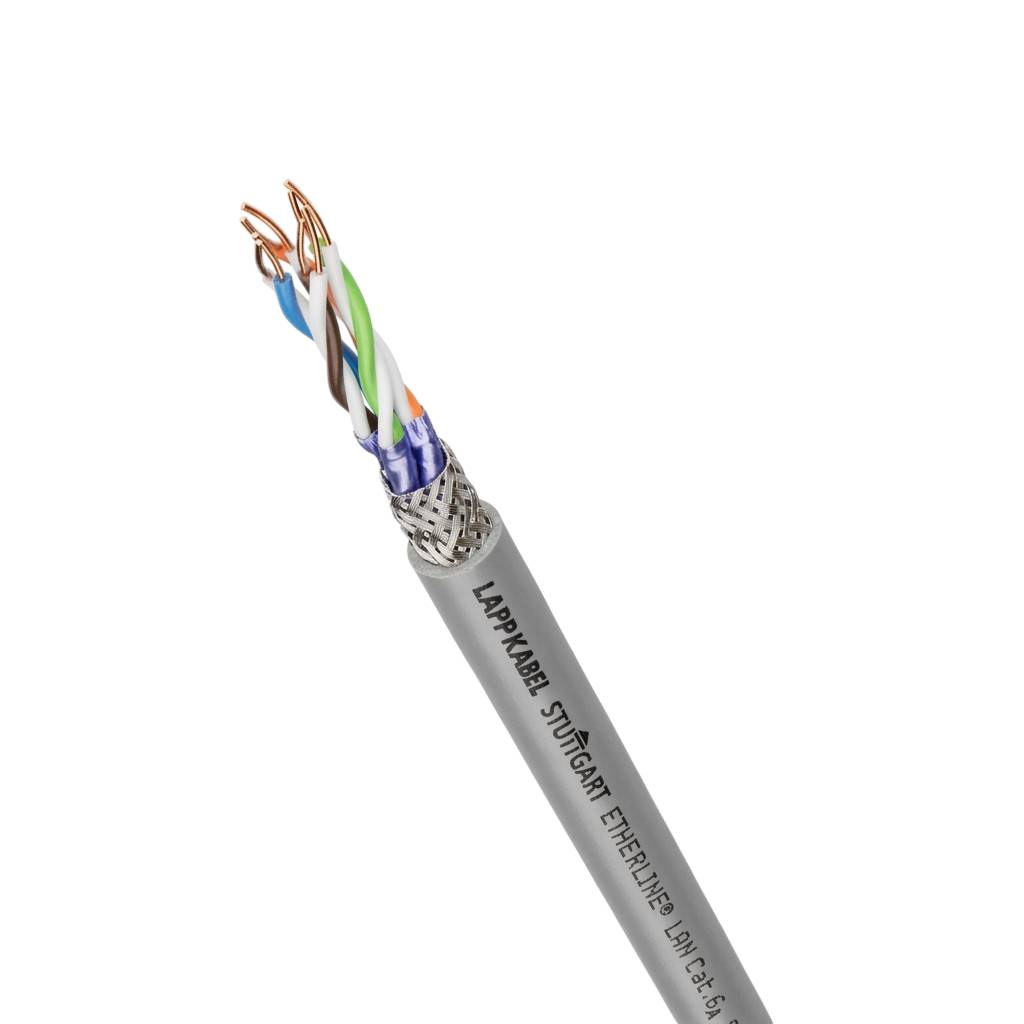
Cat6a (Category 6 Augmented) is increasingly the preferred choice for new industrial Ethernet/IP installations. Operating at up to 500 MHz — double Cat6 — it supports 10 Gigabit Ethernet reliably over the full 100-meter distance. Its augmented shielding eliminates alien crosstalk (AXT), making it highly resistant to interference from adjacent cables and external EMI sources.
Cat6a's thicker, more robust sheathing makes it well-suited to industrial environments, and its ability to handle 10 Gbps means the infrastructure will not need replacement as bandwidth demands grow with IIoT, Industry 4.0 data collection, and machine vision systems. For any new industrial network build or major upgrade in 2025, Cat6a is the recommended standard.
Cat7 — Maximum Shielding for High-EMI Environments
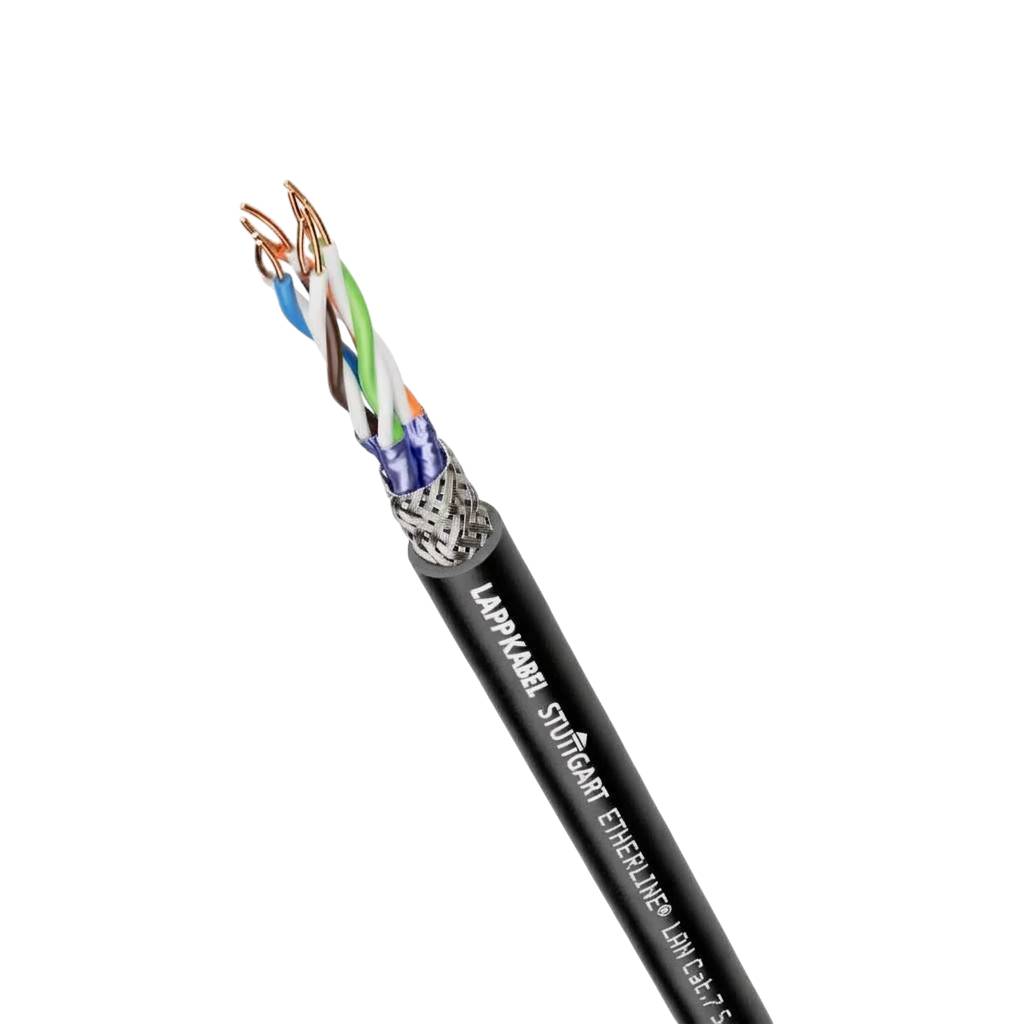
Cat7 (Category 7) features individual shielding around each wire pair (S/FTP), plus an overall outer shield — the highest level of EMI protection available in standard copper cable. It operates at 600 MHz and supports 10 Gbps over 100 meters.
Cat7 is the right choice for genuinely demanding electromagnetic environments: heavy steel manufacturing, facilities with large induction motors, welding robots, or broadcasting and medical environments. Note that Cat7 uses specialized GG45 or TERA connectors rather than standard RJ45, and is not officially recognized by TIA/EIA — so compatibility with standard network equipment should be confirmed before specifying it.
6. Cable Comparison: Which Category Should You Choose?
Specification | Cat5e | Cat6 | Cat6a | Cat7 |
|---|---|---|---|---|
Max Bandwidth | 100 MHz | 250 MHz | 500 MHz | 600 MHz |
Max Data Rate | 1 Gbps | 1 Gbps (10G@55m) | 10 Gbps | 10 Gbps |
Max Distance | 100 m | 100 m (1G) / 55 m (10G) | 100 m | 100 m |
Shielding Options | UTP / F-UTP | UTP / F-UTP / U-FTP | U-FTP / S-FTP | S/FTP (all pairs) |
Connector Type | RJ45 | RJ45 | RJ45 | GG45 / TERA |
EMI Protection | Basic | Moderate | High | Maximum |
Industrial Fit | Light duty | Standard industrial | Heavy industrial (recommended) | Extreme EMI environments |
Relative Cost | Lowest | Low–Medium | Medium | High |
TIA/EIA Standard | Yes | Yes | Yes | ISO/IEC only |
Shielding Quick Reference: UTP = Unshielded Twisted Pair | F/UTP = Foil-shielded overall, unshielded pairs | U/FTP = No overall shield, foil per pair | S/FTP = Braid + foil overall, foil per pair. For industrial Ethernet/IP in moderate-to-high EMI environments, always prefer shielded variants (F/UTP at minimum, S/FTP for Cat7). |
Choosing the Right Cable: A Practical Guide
Your Scenario | Recommended Cable |
|---|---|
Small retrofit, low-noise environment, limited budget | Cat5e (F/UTP) — meets ODVA's minimum recommendation |
Standard factory floor, moderate EMI from motors/drives | Cat6 (F/UTP or U-FTP) — good crosstalk performance, widely available |
New industrial build, IIoT/Industry 4.0 planning, 10G backbone | Cat6a (S/FTP) — best balance of performance, cost & future-proofing |
Extreme EMI: steel mills, welding bays, high-power switchgear | Cat7 (S/FTP) — individual pair + overall shielding for maximum protection |
Runs exceeding 100 meters or outdoor/inter-building connections | Fiber Optic — Ethernet/IP fully supports single-mode and multimode fiber |
7. Buy Industrial Ethernet Cables on Eleczo.
Selecting the right Ethernet cable is critical for Ethernet/IP network reliability — but sourcing genuine, quality-tested cable from a trusted supplier is equally important. Counterfeit or substandard cables are a documented problem in the market, and in industrial environments the consequences can be costly downtime or safety incidents.
Eleczo. stocks a comprehensive range of industrial-grade Network cables, patch cords, and networking accessories from trusted manufacturers — all verified for performance in industrial and commercial environments.
Shop Ethernet Cables on Eleczo: Visit www.eleczo.com to find the right cable for your Ethernet/IP network — from cost-effective Cat5e patch cords to heavy-duty shielded Cat6a and Cat7 cables built for demanding industrial environments. |
Cable Type | Best For | Key Feature |
|---|---|---|
Cat5e UTP & STP | Standard Ethernet/IP I/O nodes | Cost-effective, meets ODVA minimum |
Cat6 UTP / F-UTP | Factory floor and panel wiring | Improved SNR, 250 MHz bandwidth |
Cat6a S/FTP | 10G-ready industrial installations | Eliminates alien crosstalk, 500 MHz |
Cat7 S/FTP | High-EMI industrial environments | Individual pair shielding, 600 MHz |
Fiber Optic | Long-distance or inter-building runs | Immune to EMI, unlimited distance |
Patch Panels & Accessories | Structured cabling completion | RJ45 connectors, keystones, cable tools |
8. Ethernet/IP vs. Other Industrial Protocols
Ethernet/IP is not the only industrial Ethernet protocol in use. Understanding how it compares to alternatives helps engineers and procurement teams make the right architectural decision for their facility.
Protocol | Governing Body | Key Strength | Typical Use Case |
|---|---|---|---|
Ethernet/IP | ODVA | Open standard, IT/OT convergence, large vendor ecosystem | Allen-Bradley / Rockwell, North American facilities |
PROFINET | PI International | IRT for sub-ms motion control precision | Siemens PLC environments, European manufacturing |
EtherCAT | ETG | Extremely fast cycle times | High-speed servo systems, robotics |
Modbus TCP | Modbus Organization | Simplicity, legacy compatibility | Simple device integration, legacy retrofits |
POWERLINK | EPSG | Deterministic, real-time, open-source stack | Motion control, B&R Automation systems |
The Protocol Decision Often Follows the Controls Platform: If your facility runs Allen-Bradley / Rockwell Automation PLCs, Ethernet/IP is the natural default. For Siemens PLC environments, PROFINET is typically the stronger choice. Many modern facilities run multiple protocols and use protocol gateways to bridge them. |
Conclusion
Ethernet/IP is the proven, globally supported industrial communication standard that brings standard Ethernet infrastructure to the demands of the factory floor. Built on the Common Industrial Protocol (CIP) and running over unmodified IEEE 802.3 Ethernet, it delivers the real-time communication, scalability, and IT/OT convergence that modern industrial operations require.
The physical foundation of any Ethernet/IP network — the cable — is a critical design decision. ODVA recommends Cat5e as the minimum; for new industrial installations, Cat6a (S/FTP) offers the best balance of 10G performance, shielding, and future-proofing. For extreme EMI environments, Cat7's individual pair shielding provides the maximum protection available in copper.
Eleczo.com stocks the full range of industrial Ethernet cables and networking accessories to support your Ethernet/IP deployment — from basic Cat5e patch cords to heavy-duty shielded Cat6a and Cat7 cable for the most demanding environments. Visit www.eleczo.com to explore the full range.
Frequently Asked Questions (FAQ)
Q: What does "IP" stand for in Ethernet/IP?
In Ethernet/IP, "IP" stands for Industrial Protocol — not Internet Protocol. It refers to the Common Industrial Protocol (CIP) running over the Ethernet infrastructure. The coincidence with the familiar "IP" in TCP/IP can cause confusion, but the two are distinct concepts.
Q: Can I use regular commercial Ethernet cable for Ethernet/IP networks?
Technically yes, since Ethernet/IP runs on standard Ethernet infrastructure. However, ODVA recommends Cat5e or higher, and in environments with significant EMI — motors, drives, welding equipment — a shielded cable (F/UTP or S/FTP Cat6a) is strongly advisable to prevent data corruption and network instability.
Q: What is the difference between Cat6 and Cat6a for industrial use?
Cat6 supports 10 Gbps only up to approximately 55 meters, whereas Cat6a supports 10 Gbps over the full 100-meter maximum cable run. Cat6a also features augmented shielding that eliminates alien crosstalk between adjacent cables — a significant advantage in cable-dense industrial panel or conduit environments. For new industrial installations, Cat6a is generally the better long-term investment.
Q: Is Ethernet/IP the same as standard office Ethernet?
No. Ethernet/IP shares the same physical infrastructure (cabling, switches, IP addressing) as office Ethernet, but adds the CIP application layer on top. CIP enables device-level industrial communication — I/O control, motion, safety, energy management — that standard office protocols cannot provide.
Q: Does Cat7 work with standard RJ45 connectors?
Cat7 was originally designed to use GG45 or TERA connectors, which differ from standard RJ45. Many Cat7 cables sold today use RJ45 terminations, which technically downgrades them to Cat6a performance at the connector point. For true Cat7 performance, verify that the full channel — cable, connectors, and patch panels — is Cat7 compliant. Also note that Cat7 is not recognized by the TIA/EIA standard, only ISO/IEC.
Q: What cable length limits apply for Ethernet/IP networks?
Standard copper Ethernet cable (Cat5e through Cat7) has a maximum segment length of 100 meters (approximately 328 feet). For longer runs — such as connecting buildings or running cable across a large facility — fiber optic cable is recommended. Ethernet/IP fully supports both single-mode and multimode fiber for extended-distance links.
Q: How does Ethernet/IP support Industry 4.0 and IIoT?
Because Ethernet/IP runs on standard, unmodified Ethernet, it naturally integrates with enterprise IT systems, cloud platforms, and IIoT gateways. Data from PLCs, sensors, and drives can flow through the same network infrastructure to MES, ERP, and analytics platforms — enabling the IT/OT convergence that is central to Industry 4.0.