What Is HFFR Cable Insulation? Benefits and Uses

When you look at a cable, you mostly see the outer cover. But that cover does a very important job. It protects the wires inside and, in case of a fire, it can mean the difference between a small incident and a serious disaster.
That outer cover — called the cable insulation — has gone through a big upgrade in recent years. One of the most important upgrades is HFFR insulation. It is now used widely in buildings, factories, data centers, and public spaces all around the world.
In this guide, we will explain what HFFR cable insulation is, why it matters, and which internet cables — Cat5e, Cat6, Cat6A, and Cat7 — use it. We will also help you find the right cable for your needs.
What Is HFFR Cable Insulation?
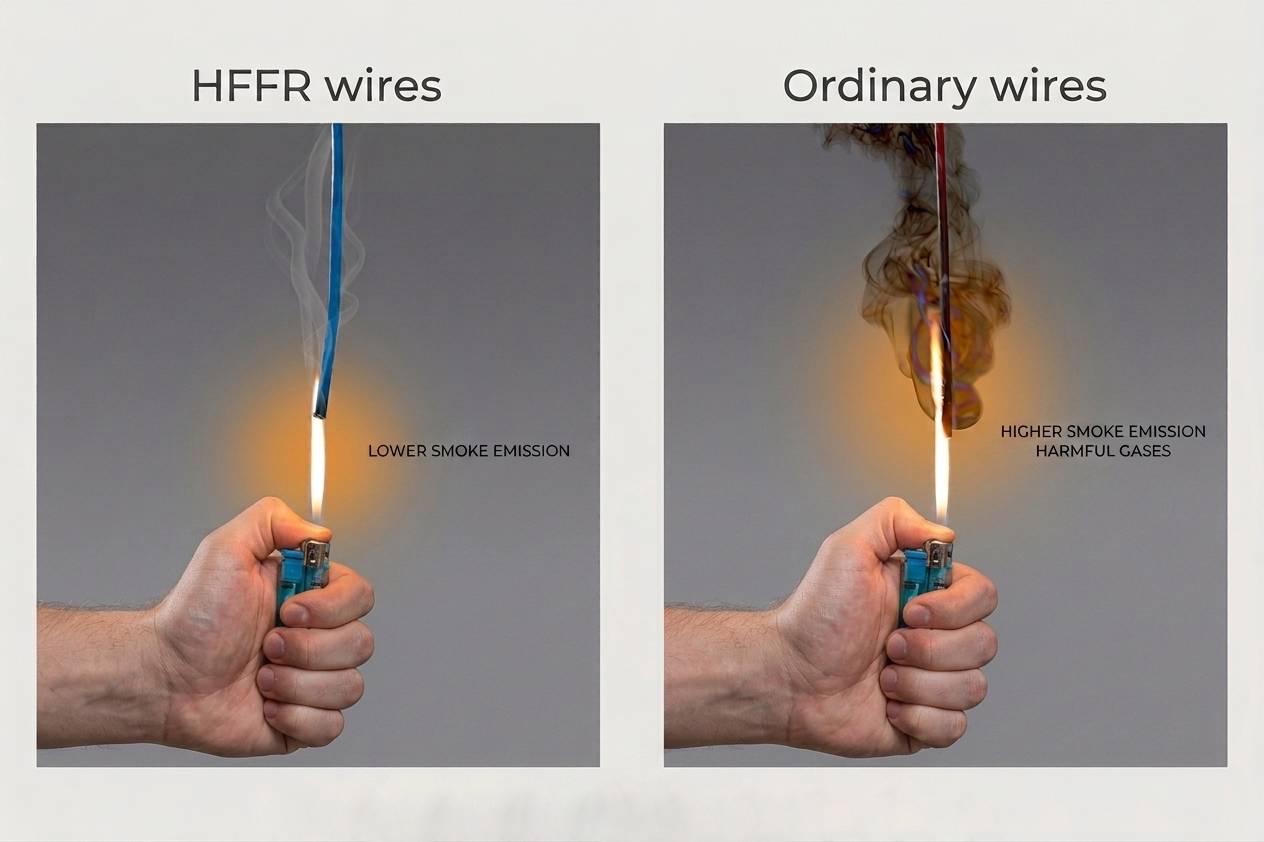
HFFR stands for Halogen-Free Flame Retardant. It is a special type of material used to coat and protect cables.
Traditional cable insulation often uses materials that contain halogens — a group of chemicals that includes chlorine, fluorine, and bromine. These halogens are good at slowing down fire, but when they burn, they release toxic gases and thick black smoke. This can be extremely dangerous to people inside a building during a fire.
HFFR insulation removes halogens completely. It still slows down fire, but when it does burn, it produces very little smoke and no toxic gases. This makes it much safer for people and for electronic equipment nearby.
In simple terms: HFFR cables slow fire without poisoning the air. That is why they are the smart choice for schools, hospitals, offices, and public buildings.
How Does HFFR Insulation Work?
HFFR materials are made using compounds like polyolefin blends with inorganic flame retardants such as aluminium trihydrate (ATH) or magnesium hydroxide. When these compounds are exposed to heat or fire, they release water molecules that cool the material and slow the burning process.
The result is a cable that:
Resists fire — it does not catch fire easily
Limits flame spread — it slows fire from moving along the cable
Produces low smoke — visibility stays higher in an emergency
Releases no halogen gases — no toxic fumes that harm people or corrode equipment
Why Does HFFR Insulation Matter So Much?
1. People Safety During Fires
Most fire-related deaths are not caused by burns — they are caused by smoke inhalation. Toxic gases from burning halogen-based cables can incapacitate a person within minutes. HFFR insulation dramatically reduces this risk by eliminating those dangerous gases.
2. Equipment Protection
Halogen gases are not only dangerous to people — they are also corrosive to electronic equipment. In data centers and server rooms, a cable fire with halogen-based insulation can permanently damage expensive servers and networking gear. HFFR cables prevent this secondary damage.
3. Environmental Responsibility
Halogen compounds are harmful to the environment when cables are disposed of or recycled. HFFR materials are more eco-friendly and align with green building certifications such as LEED and BREEAM.
4. Compliance and Regulations
Many countries and building codes now require HFFR cables in public buildings. In Europe, the CPR (Construction Products Regulation) mandates certain cable fire performance classes, and HFFR cables meet these standards. In India, standards like IS 7098 also recognize and recommend low-smoke, halogen-free cables.
HFFR vs PVC Cable Insulation: What Is the Difference?
PVC (Polyvinyl Chloride) is the most traditional cable insulation material. It is cheap and widely used, but it contains chlorine — a halogen. Here is a quick comparison:
Feature | PVC Insulation | HFFR Insulation |
|---|---|---|
Halogen Content | Yes (Chlorine) | None |
Smoke on burning | Dense, black | Low, minimal |
Toxic gas release | Yes (HCl gas) | No |
Flame resistance | Moderate | High |
Cost | Lower | Slightly higher |
Eco-friendly | Less so | More so |
Recommended for | General use | Public & critical spaces |
As the table shows, HFFR is the clear winner for any environment where safety, compliance, and equipment protection are priorities.
HFFR Insulation in Internet Cables: Cat5e, Cat6, Cat6A, and Cat7
Now let us get practical. HFFR insulation is increasingly being used in Ethernet and structured network cables. Let us look at the four most popular types and how HFFR benefits each one.
Cat5e HFFR Cable
Cat5e (Category 5 enhanced) is one of the most widely installed network cables in the world. It supports speeds of up to 1 Gbps and a bandwidth of 100 MHz. It is perfect for home networks, small offices, and budget-friendly projects.
With HFFR insulation, Cat5e cables become suitable for use in:
Schools and universities
Residential buildings with multiple floors
Hospitality environments like hotels
Looking for Cat5e with HFFR insulation? You can explore our range of Cat5e Ethernet Cables on Eleczo, that meet modern safety standards.
Cat6 HFFR Cable
Cat6 cables support up to 10 Gbps over short distances and offer 250 MHz bandwidth. They are the most popular choice today for commercial office cabling, thanks to their excellent performance-to-cost ratio.
HFFR Cat6 cables are ideal for:
Open-plan offices
Co-working spaces
Retail environments
Any building where cable bundles run through shared spaces
Find high-quality Cat6 HFFR Cables on Eleczo, — trusted by network professionals across India.
Cat6A HFFR Cable
Cat6A (Augmented Category 6) is the professional-grade choice for demanding networks. It supports 10 Gbps over full 100-metre runs and operates at 500 MHz bandwidth.
Cat6A with HFFR insulation is the standard for:
Data centers and server rooms
Hospitals and healthcare facilities
Government and defence buildings
High-density enterprise environments
The low-smoke, halogen-free properties of Cat6A HFFR cables mean that in a critical facility like a hospital, a cable fault will not compromise air quality or damage sensitive medical equipment.
Shop for Cat6A HFFR Cables on Eleczo, — built for performance and safety in the most critical environments.
Cat7 HFFR Cable
Cat7 is the most advanced shielded twisted pair cable in this group. It supports 10 Gbps at 600 MHz and features individual pair shielding (SSTP/PIMF) that eliminates crosstalk almost entirely.
When combined with HFFR insulation, Cat7 becomes the ultimate cable for:
Broadcast studios and media production
Industrial automation environments
Financial trading floors
Any location requiring maximum performance and maximum safety
Explore Cat7 HFFR Cables on Eleczo, — where uncompromising performance meets uncompromising safety.
Quick Comparison: HFFR Internet Cables at a Glance
Cable Type | Max Speed | Bandwidth | Best Use |
|---|---|---|---|
Cat5e | Up to 1 Gbps | 100 MHz | Great for homes, small offices |
Cat6 | Up to 10 Gbps (short range) | 250 MHz | Best balance of speed & cost |
Cat6A | Up to 10 Gbps (longer range) | 500 MHz | Ideal for data centers, enterprises |
Cat7 | Up to 10 Gbps | 600 MHz | High-performance, fully shielded |
Where Should You Use HFFR Cables?
HFFR cables are recommended — and in many cases required — in the following locations:
Public buildings: schools, libraries, government offices, airports
Healthcare: hospitals, clinics, diagnostic labs
Commercial offices: especially high-rise or densely occupied buildings
Data centers: to protect servers and networking equipment from corrosive gases
Industrial facilities: factories and plants where fire risk is higher
Hotels and hospitality: for occupant safety and compliance
Residential towers: particularly where cabling runs through common areas and shafts
Rule of thumb: If people are present, or if expensive equipment needs protection, HFFR is the right choice.
How to Identify HFFR Cables
When buying cables, here is what to look for to confirm HFFR compliance:
Marking on the cable jacket: Look for "LSZH" (Low Smoke Zero Halogen), "HFFR", or "LS0H" printed on the cable outer jacket.
Product datasheet: The manufacturer should specify halogen content (should be zero) and smoke density values.
Certifications: IEC 60754 (halogen content test), IEC 61034 (smoke density test), and IEC 60332 (flame propagation test) are the key standards.
Color: HFFR cables often come in lighter colors like white or light grey, but color alone is not a reliable indicator — always check the markings.
Buy HFFR Internet Cables on Eleczo.com
At Eleczo, we stock a wide range of HFFR-rated network cables from trusted brands. Whether you need Cat5e for a home setup, Cat6 for a commercial office, Cat6A for a data center, or Cat7 for a high-performance industrial environment — we have the right cable for you.
Here is why thousands of professionals and businesses buy from Eleczo:
Genuine products: All cables are sourced directly from verified manufacturers.
Wide selection: Cat5e, Cat6, Cat6A, Cat7 available in various lengths and reel sizes.
Compliance ready: Products come with datasheets and certification details.
Competitive pricing: Best prices without compromising on quality.
Fast delivery: Pan-India shipping for projects big and small.
Browse our full range of HFFR network cables at www.eleczo.com and make the safer, smarter choice for your next cabling project.
Conclusion
HFFR cable insulation is not just a technical upgrade — it is a safety upgrade that protects people, buildings, and equipment. As fire safety standards tighten globally and awareness of toxic smoke risks grows, HFFR cables are rapidly becoming the default choice for responsible cable installations.
Whether you are setting up a home network with Cat5e, upgrading an office with Cat6, building out a data center with Cat6A, or deploying a high-performance industrial network with Cat7 — choosing HFFR insulation is one of the best decisions you can make.
And when you are ready to buy, Eleczo is your trusted source for verified, compliant HFFR network cables at the best prices in India.
Frequently Asked Questions (FAQs)
Is HFFR the same as LSZH?
Yes, HFFR and LSZH (Low Smoke Zero Halogen) are often used interchangeably. Both refer to cable insulation that contains no halogens and produces minimal smoke. Some standards use one term and some use the other, but the key properties are the same.
Are HFFR cables more expensive than PVC cables?
HFFR cables do cost a little more than standard PVC cables — typically 10 to 25 percent more, depending on the cable type and brand. However, when you factor in the improved safety, potential compliance requirements, and equipment protection, the additional cost is well justified.
Can I use HFFR cables outdoors?
HFFR insulation itself is not designed specifically for outdoor use. For outdoor installations, look for cables that are both HFFR and UV-resistant, or have an additional PE (polyethylene) outer jacket. Always check the product specifications before outdoor installation.
Do HFFR cables affect network performance?
No — HFFR insulation has no negative effect on electrical performance. A Cat6 HFFR cable performs exactly the same as a Cat6 PVC cable in terms of speed, bandwidth, and signal quality. The difference is entirely in the safety profile of the insulation material.