What Does 24 AWG Mean in Ethernet Cables? Explained

If you have ever bought or looked up an Network cable, you may have noticed small print on the cable jacket that says something like "24 AWG." It might seem like just a technical detail, but it actually tells you a lot about how that cable will perform in your home, office, or server room.
In this guide, we will break down exactly what 24 AWG means, why it matters for signal transmission, and how it compares across popular cable types like Cat5e, Cat6, Cat6A, and Cat7. By the end, you will know exactly which cable is right for your setup.
What Does AWG Mean?
AWG stands for American Wire Gauge. It is a standardised system used to measure the diameter of the copper conductor inside a cable. Think of it like a sizing chart for wires.
Key Rule: The smaller the AWG number, the thicker the wire. The larger the AWG number, the thinner the wire. |
So a 24 AWG wire is thicker than a 26 AWG wire, and thinner than a 22 AWG wire. This difference in thickness has a direct impact on performance, especially when it comes to signal quality over long distances.
What Does 24 AWG Mean in an Ethernet Cable?
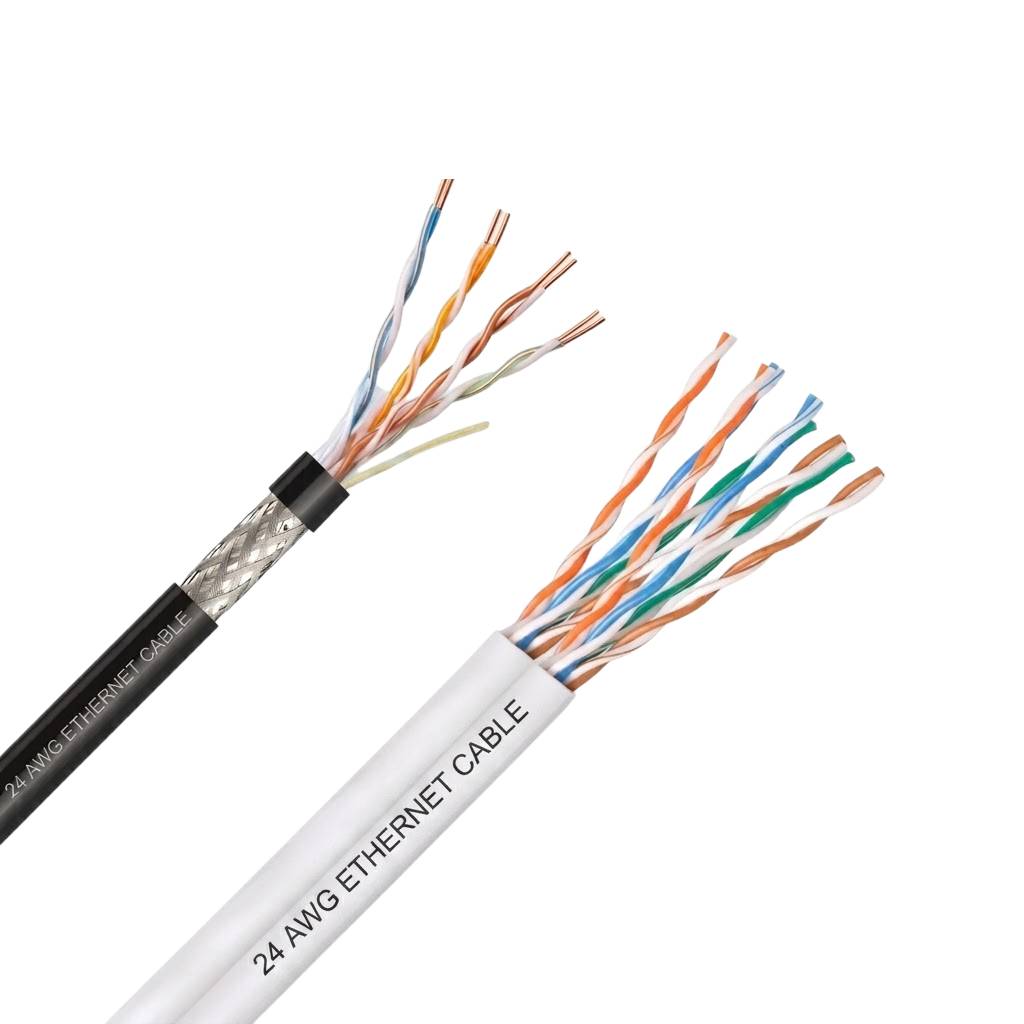
When you see "24 AWG" printed on an Ethernet cable, it means that each individual copper conductor inside the cable has a diameter that corresponds to the 24 gauge standard on the AWG scale.
A typical Ethernet cable contains eight copper wires, arranged in four twisted pairs. In a 24 AWG cable, each of those eight wires is 24 gauge, which gives them a physical diameter of approximately 0.511 mm.
Why does that matter? Because thicker copper means:
Lower electrical resistance: less energy is lost as the signal travels through the wire.
Better signal strength at long distances: the signal stays strong across the full length of the cable.
Better support for Power over Ethernet (PoE): thicker conductors can safely carry more electrical current to power devices like IP cameras or Wi-Fi access points.
How 24 AWG Affects Signal Transmission
Signal transmission is all about how cleanly and reliably data moves from one end of a cable to the other. The AWG rating of the cable plays a big role in this.
Attenuation (Signal Loss)
Every cable experiences some signal loss over distance. This is called attenuation. The thicker the conductor, the less attenuation occurs. A 24 AWG cable has lower resistance than a 26 AWG or 28 AWG cable, which means less signal is lost as data travels from your router to your device.
This is why 24 AWG cables are strongly recommended for permanent installations, like cables run through walls, ceilings, or along long corridors. They are rated to reliably transmit data up to the full 100 metres (328 feet) specified in TIA/EIA-568 standards for Cat5e, Cat6, and Cat6A.
Power over Ethernet (PoE) Performance
PoE technology lets your network cable carry both data and electrical power at the same time. This is how devices like IP security cameras, VoIP phones, and wireless access points get their power without a separate power cable.
When current flows through a wire, heat is generated. Thinner wires generate more heat because they have higher resistance. With higher power PoE standards (PoE+ and PoE++), using a thin cable can cause overheating, voltage drop, or even damage.
A 24 AWG cable handles PoE applications with ease, making it the safe and reliable choice for any setup that powers devices through the cable.
Durability and Long-Term Reliability
Cables installed in walls and ceilings need to last for years without degradation. The thicker copper in a 24 AWG cable makes it more durable and less prone to damage during installation, handling, or long-term use in fixed infrastructure.
24 AWG Across Cable Categories: Cat5e, Cat6, Cat6A, and Cat7
The AWG rating does not exist in isolation. It works alongside the cable category to define overall performance. Here is how 24 AWG plays a role across the most popular Ethernet cable types:
Cat5e with 24 AWG
Cat5e (Category 5 Enhanced) is one of the most widely used Ethernet cables in homes and small offices. It supports speeds up to 1 Gbps at distances of up to 100 metres and operates at a bandwidth of 100 MHz.
Most permanent Cat5e installations use 24 AWG solid copper conductors. This gives Cat5e cables the signal strength and reliability needed for everyday internet use, streaming, and basic office networking.
If you need a reliable, budget-friendly cable for standard home or small office use, a 24 AWG Cat5e cable is a solid starting point.
Shop Cat5e Cables on Eleczo: Explore our range of 24 AWG Cat5e Ethernet cables at eleczo.com, built for reliable everyday networking at home and in the office. |
Cat6 with 24 AWG
Cat6 (Category 6) is a step up from Cat5e. It supports speeds up to 10 Gbps at shorter distances (up to 55 metres) and 1 Gbps at the full 100-metre range. It operates at a higher bandwidth of 250 MHz and often features a physical separator called a spline between the four pairs to reduce crosstalk.
Cat6 cables typically use 23 AWG or 24 AWG conductors. A 24 AWG Cat6 cable still delivers strong performance for most home and office environments, particularly where cable runs are under 55 metres and 10 Gbps speeds are needed.
Cat6 is backward compatible with Cat5e and is the current sweet spot for most residential and small business installations.
Shop Cat6 Cables on Eleczo: Find high-quality 24 AWG Cat6 Ethernet cables at eleczo.com, ideal for home networks, gaming setups, and small business infrastructure. |
Cat6A with 24 AWG
Cat6A (Augmented Category 6) is the professional's choice for future-proof networking. It supports 10 Gbps at the full 100-metre distance and operates at an impressive 500 MHz bandwidth, double that of standard Cat6.
Cat6A cables commonly use 23 AWG or 24 AWG conductors, and the augmented design significantly reduces alien crosstalk, which is interference picked up from nearby cables. This makes Cat6A the preferred cable in environments with heavy cable density, such as offices, hospitals, and schools.
Cat6A also provides excellent support for high-power PoE++ applications, as the thicker conductors keep heat generation low even under heavy electrical loads.
If you are doing a fresh installation in 2025 and want your cabling to last the next decade, Cat6A is the safest and most future-proof choice.
Shop Cat6A Cables on Eleczo: Browse our Cat6A Ethernet cables at eleczo.com, built for 10 Gbps at full distance and high-density professional environments. |
Cat7 with 22-23 AWG
Cat7 (Category 7) is the highest-performance copper Ethernet cable in common use. It supports 10 Gbps at 100 metres and operates at 600 MHz. Cat7 cables feature individually shielded pairs (S/FTP construction), which provides superior protection against electromagnetic interference.
Cat7 cables typically use 22 AWG or 23 AWG conductors, making them slightly thicker than a standard 24 AWG cable. This extra thickness, combined with per-pair shielding, makes Cat7 ideal for environments with high levels of electrical interference, such as industrial settings or AV production studios.
One important note: Cat7 uses proprietary GG45 or TERA connectors rather than the standard RJ-45 plug. This means it is not natively compatible with most consumer or office networking equipment without adapters, and it is not endorsed as a standard by the TIA (Telecommunications Industry Association). For most home and office users, Cat6A delivers equivalent performance with better compatibility.
Shop Cat7 Cables on Eleczo: Check out our Cat7 Ethernet cables at eleczo.com for high-shielding, high-performance network installations in demanding environments. |
Quick Comparison: Cat5e vs Cat6 vs Cat6A vs Cat7
Cat6 achieves 10 Gbps only up to 55 metres. At full 100m, it delivers 1 Gbps.
Feature | Cat5e | Cat6 | Cat6A | Cat7 |
|---|---|---|---|---|
Max Speed | 1 Gbps | 10 Gbps* | 10 Gbps | 10 Gbps |
Max Distance | 100 m | 55 m (10G) | 100 m | 100 m |
Bandwidth | 100 MHz | 250 MHz | 500 MHz | 600 MHz |
Typical AWG | 24 AWG | 23–24 AWG | 23–24 AWG | 22–23 AWG |
Shielding | UTP | UTP/STP | UTP/STP | S/FTP |
PoE Support | Yes | Yes | Yes (PoE++) | Yes (PoE++) |
Best For | Home/SOHO | Home/Office | Office/Enterprise | Enterprise/AV |
When Should You Choose a 24 AWG Ethernet Cable?
Here is a simple guide to help you decide:
Home internet and streaming: A 24 AWG Cat5e or Cat6 cable gives you all the performance you need for 4K streaming, video calls, and everyday browsing.
Home office or small business: Choose a 24 AWG Cat6 cable for reliable, fast connections across multiple desks and devices.
In-wall or in-ceiling permanent runs: Always use 24 AWG solid copper cables for fixed infrastructure. They offer better signal retention and durability than thinner stranded cables.
PoE devices (cameras, access points, phones): A 24 AWG Cat6 or Cat6A cable is the safe choice for powering devices through the network.
Enterprise and large office installations: Choose 24 AWG Cat6A for the best combination of speed, distance, and future-proofing.
Gaming setups: A 24 AWG Cat6 cable delivers low latency and consistent speeds, perfect for competitive gaming at home.
Common Misconceptions About AWG and Ethernet Cables
There are a few things people often get wrong when it comes to AWG and cable performance. Let us clear them up.
Misconception 1 - A higher AWG number means better performance: This is false. A higher AWG number means a thinner wire with more resistance. 24 AWG outperforms 26 AWG and 28 AWG over long distances.
Misconception 2 - AWG alone determines speed: Speed is determined by the cable category (Cat5e, Cat6, Cat6A, etc.). AWG affects signal quality and distance, not the rated maximum speed of the category.
Misconception 3 - All Cat6 cables are the same: Quality matters. Cheap cables made with copper-clad aluminium (CCA) instead of solid copper perform significantly worse and can cause network issues. Always look for pure copper 24 AWG cables.
Misconception 4 - Thin cables are always fine for PoE: 28 AWG cables are not suitable for high-power PoE+ or PoE++ applications. They can overheat and cause equipment damage. Stick to 24 AWG for any PoE deployment.
Buy the Right Ethernet Cable on Eleczo.
At Eleczo, we offer a wide range of high-quality 24 AWG Ethernet cables across all major categories. Whether you are setting up a home network, upgrading your office, or running cable for a professional installation, you will find the right product to match your needs.
Here is what to look for when you shop:
Cat5e 24 AWG Cables: Great for standard home and office networks where speeds up to 1 Gbps are sufficient.
Cat6 24 AWG Cables: The best all-round cable for modern homes, gaming rigs, and small business setups needing 10 Gbps on shorter runs.
Cat6A 24 AWG Cables: The professional-grade choice for 10 Gbps at full 100-metre runs and future-ready installations.
Cat7 Shielded Cables: For demanding environments with high interference, offering the best shielding available in copper cabling.
Visit www.eleczo.com to explore our full range of Ethernet cables. Each product is clearly labelled with AWG rating, cable category, shielding type, and length, so you can always buy with confidence.
Conclusion
Understanding 24 AWG is not just about knowing a cable specification. It is about making smarter decisions for your network. A 24 AWG Ethernet cable gives you lower resistance, better signal quality over longer distances, and reliable support for PoE devices, all qualities that matter whether you are setting up a simple home network or a professional office installation.
Across Cat5e, Cat6, Cat6A, and Cat7, a 24 AWG conductor is the standard for permanent cabling and dependable long-run performance. Pair the right AWG with the right cable category, and your network will be faster, more stable, and ready for the future.
Ready to shop? Visit Eleczo, and find the perfect 24 AWG Ethernet cable for your needs today.
Frequently Asked Questions
Is 24 AWG better than 26 AWG for Ethernet?
Yes, for most fixed installations. A 24 AWG cable has a thicker conductor, which means lower resistance and less signal loss over longer distances. For cables run inside walls or across large spaces, 24 AWG is the recommended choice.
Can I use a 24 AWG Cat5e cable for 10 Gbps?
No. Cat5e is limited to 1 Gbps regardless of AWG. To achieve 10 Gbps, you need at least a Cat6 cable (up to 55 metres) or a Cat6A cable (up to 100 metres).
What AWG is recommended for PoE installations?
For standard PoE (up to 15.4W), 24 AWG or 26 AWG cables work fine. For PoE+ (up to 30W) and PoE++ (up to 90W), 24 AWG or thicker is strongly recommended to prevent overheating and voltage drop.
Is Cat7 worth buying for home use?
For most home users, Cat6A is the better choice. Cat7 offers higher bandwidth and shielding, but its proprietary connectors make it incompatible with standard RJ-45 equipment. Cat6A delivers 10 Gbps at 100 metres with standard connectors, making it more practical and future-proof for home and office use.
How do I know if a cable is genuine 24 AWG solid copper?
Check the cable jacket for printed specifications including AWG rating and conductor material. Reputable cables will be marked as "pure copper" or "solid copper." Avoid cables labelled as CCA (Copper Clad Aluminium), as these are lower quality and perform poorly, especially for PoE applications.