Shielded vs Unshielded Ethernet Cables: Key Differences
If your network keeps dropping packets near a motor, an elevator shaft, or a row of fluorescent lights, the cable itself may be the problem — not your router or your ISP. The fix usually comes down to one decision: shielded ethernet cable (STP) or unshielded ethernet cable (UTP)?
Both carry the same data. Both fit the same RJ45 port. But they behave very differently once electrical noise enters the picture. This guide breaks down exactly how STP and UTP cables differ, what shielding actually protects against, where each one belongs — home, office, or industrial floor — and how to balance cost against performance when you're specifying cable for a real project.
Quick Answer: STP vs UTP
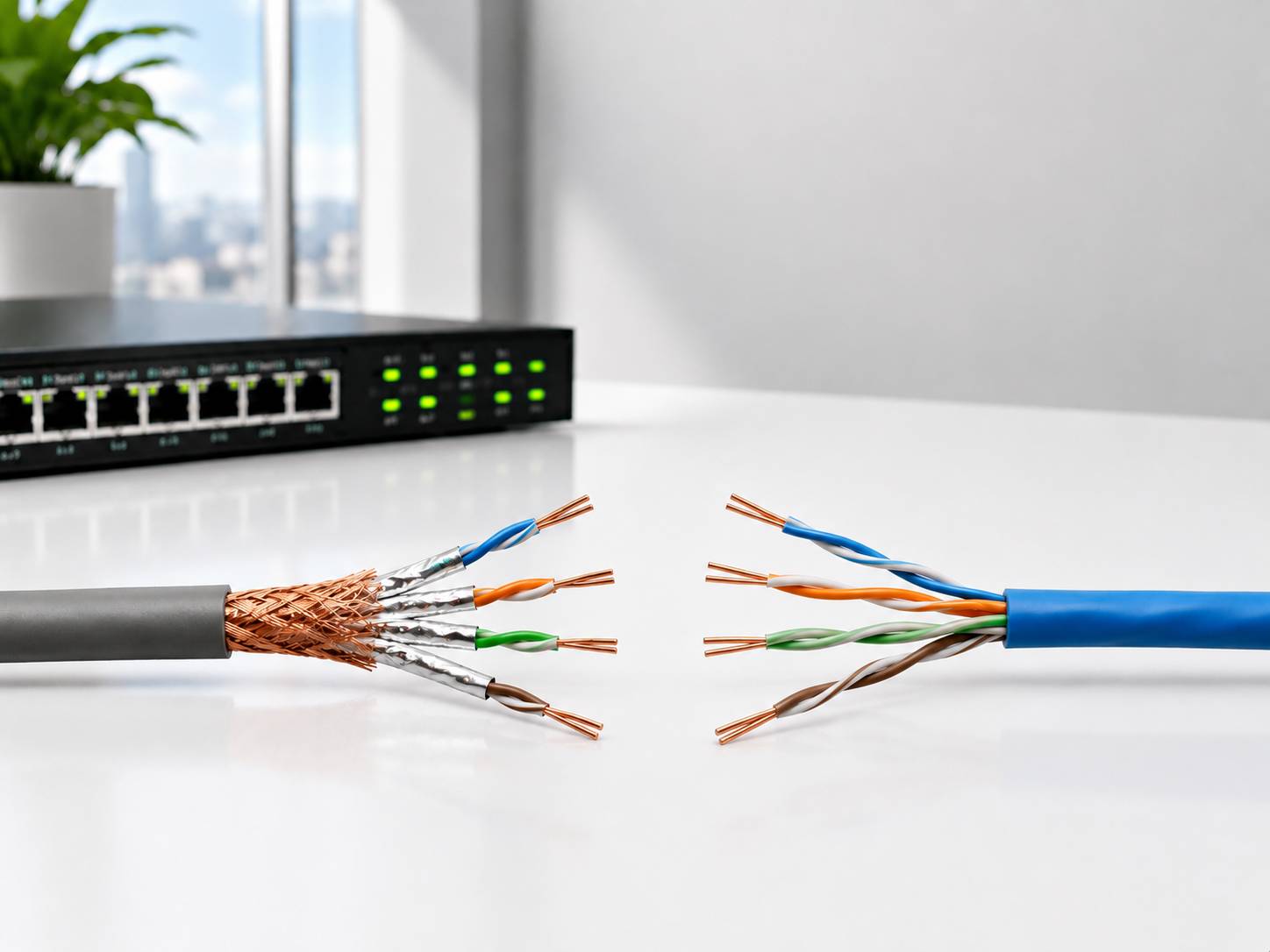
An unshielded twisted pair (UTP) cable relies only on the twist of its internal wire pairs to resist interference. A shielded twisted pair (STP) cable adds a metallic foil or braided layer around the pairs to block electromagnetic interference (EMI) and radio frequency interference (RFI). Shielded cable is the right choice near motors, inverters, high-voltage lines, and other industrial EMI sources; unshielded cable is sufficient — and more economical — for most homes, offices, and standard commercial networks.
What Is an Unshielded Ethernet Cable (UTP)?
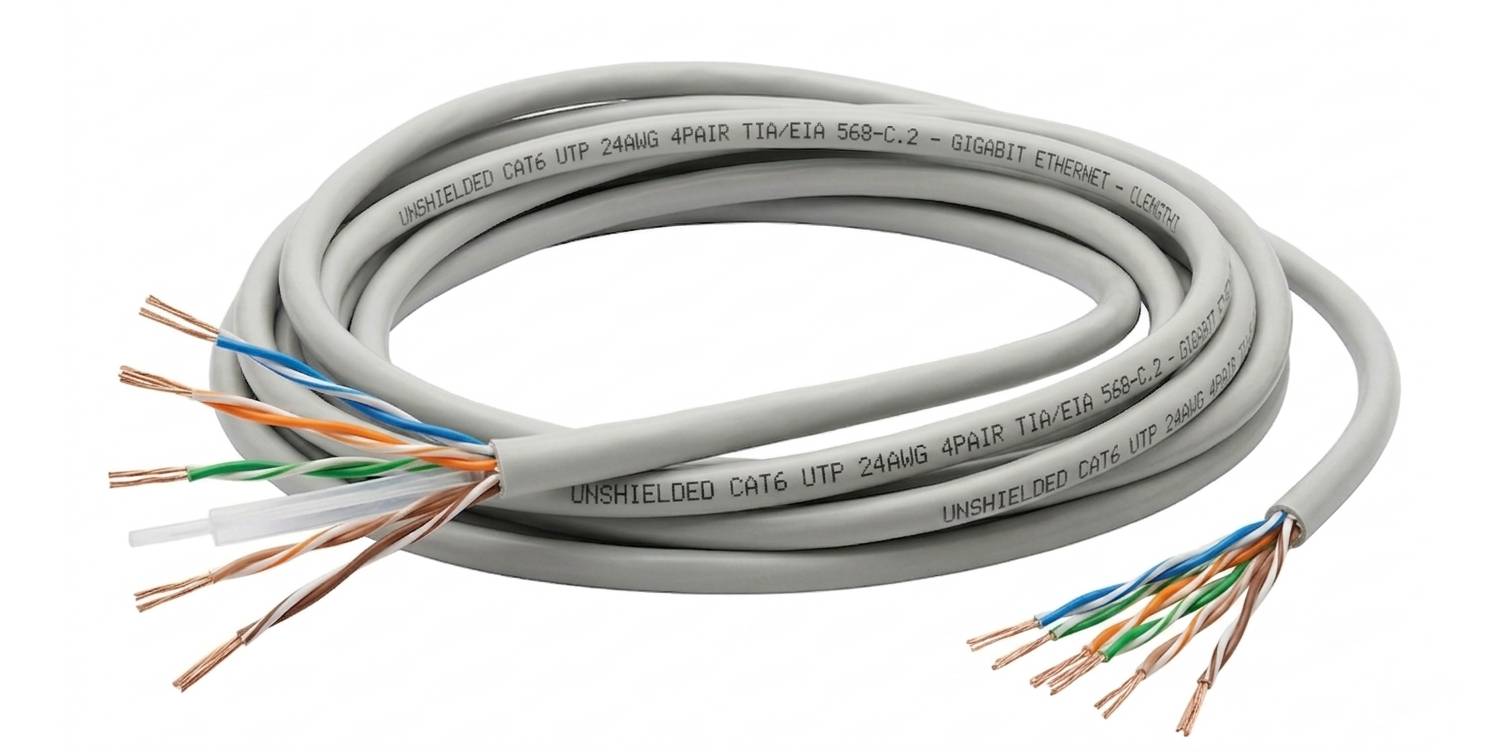
An unshielded ethernet cable contains four pairs of copper wires, each twisted at a slightly different rate. This twisting itself is what reduces noise and crosstalk, since UTP cables don't add a separate shielding layer. The pairs sit inside a single outer PVC jacket with nothing else around them.
This is the cable most people already have at home and in standard office networks — Cat5e, Cat6, and Cat6a UTP cover the vast majority of residential and commercial Ethernet runs. UTP is the standard most installations rely on because it's lighter, more flexible, and doesn't require any grounding hardware.
The trade-off is interference resistance. Without shielding, UTP cable is more vulnerable to electrical noise from nearby equipment. In a typical home or office, where the strongest nearby interference source is a Wi-Fi router or a refrigerator compressor, that vulnerability rarely matters.
What Is a Shielded Ethernet Cable (STP)?
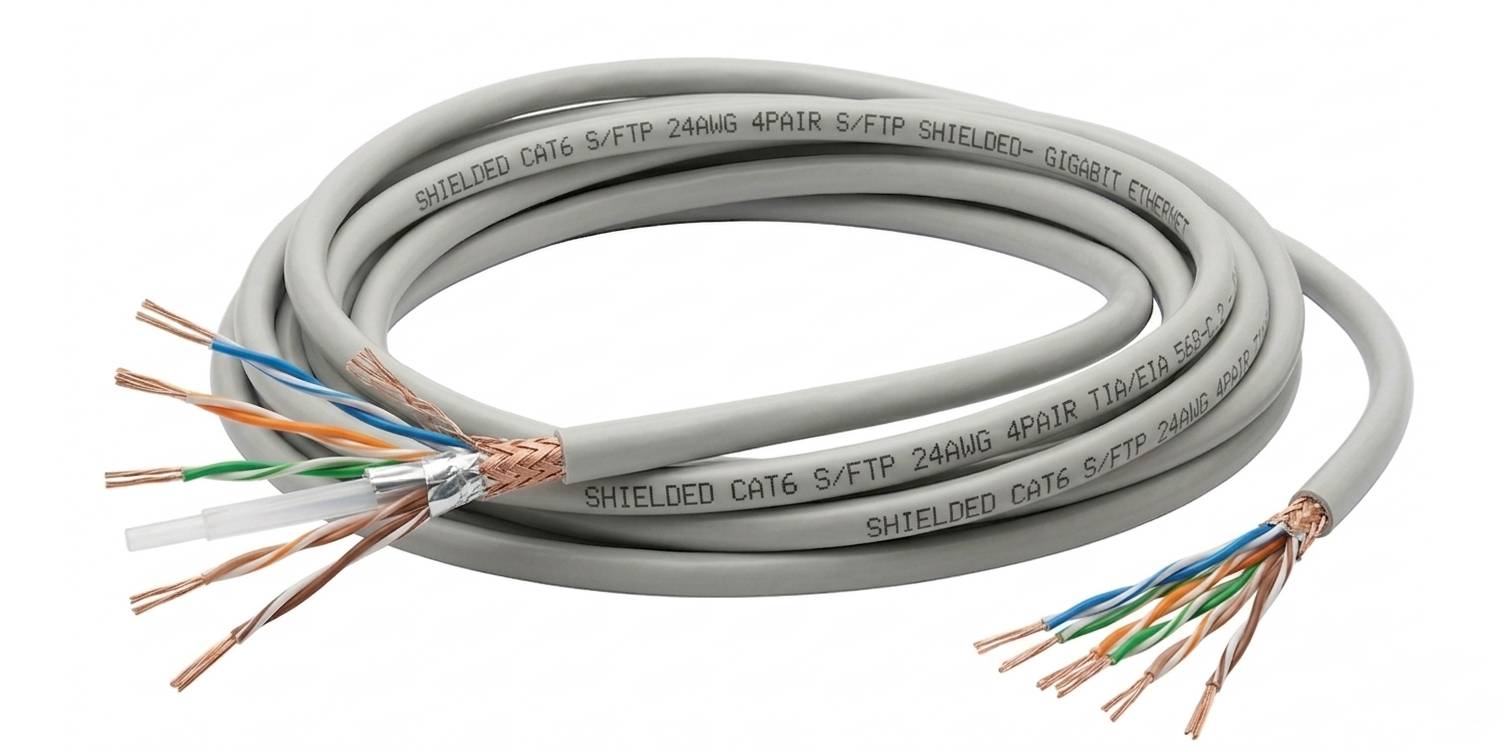
A shielded ethernet cable adds a conductive layer — foil, braided copper mesh, or both — around the twisted pairs. That barrier is designed to block electromagnetic interference and radio frequency interference before it reaches the signal-carrying conductors inside. Industry sources note that this added protection becomes valuable specifically where motors, fluorescent lighting, HVAC systems, or bundles of other cables sit close to the network run.
There's an important catch most buyers miss: a shield only works if it has somewhere to send the noise it intercepts. If a shielded cable isn't properly grounded, the shield can't discharge the electromagnetic energy it picks up, and in some cases this can make interference worse rather than better. That means shielded ethernet cable is not a drop-in replacement for UTP — it needs shielded jacks, shielded patch panels, and a deliberate grounding path at the termination point to actually deliver the protection it's designed for.
Decoding “STP”: The Shielding Naming System You'll See on Cable Jackets
“STP” gets used loosely to describe almost any shielded cable, but the international cabling standard ISO/IEC 11801 defines a more precise two-part code printed on the cable jacket: overall shield / pair shield. The letters mean:
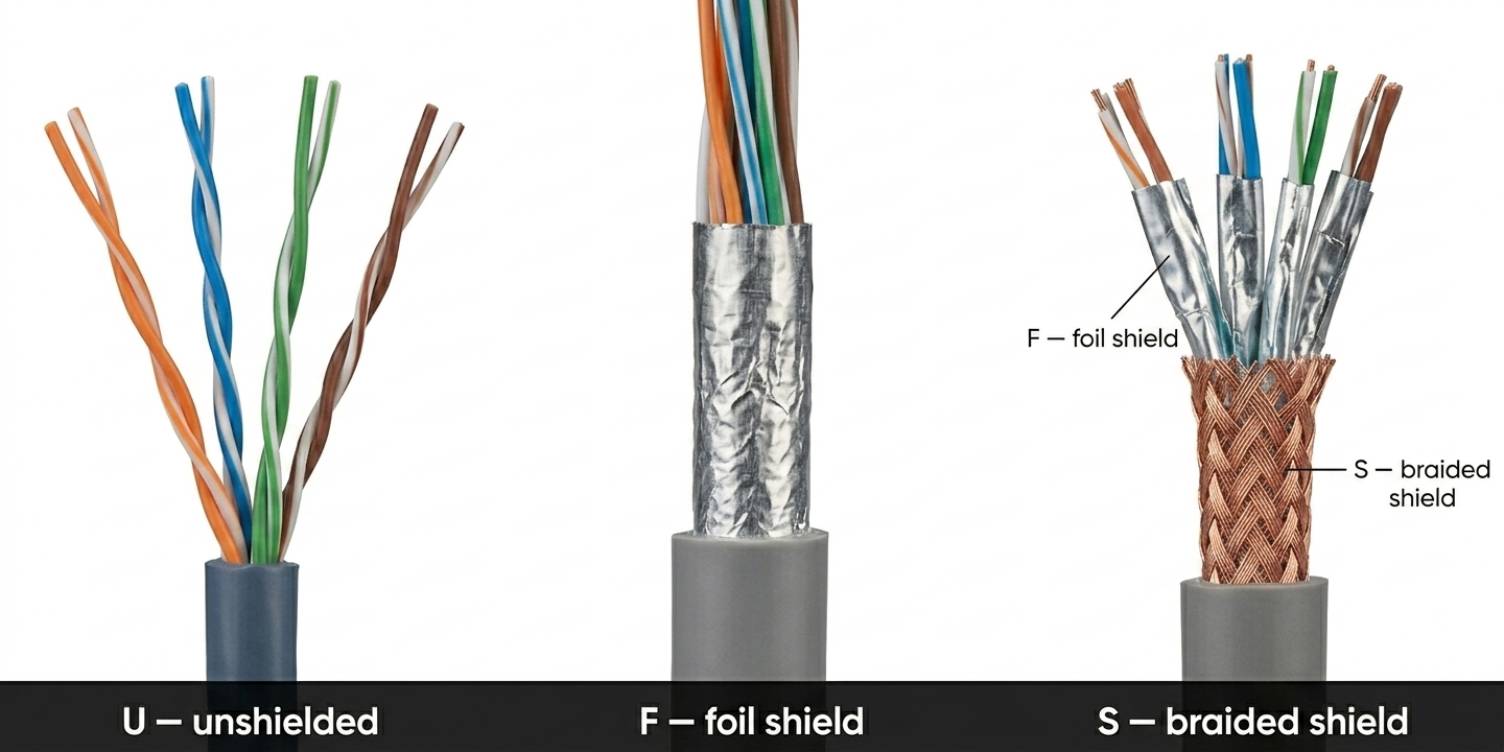
U — unshielded
F — foil shield
S — braided shield
Code | What it means | Typical use case |
|---|---|---|
U/UTP | No shielding at all (standard “UTP”) | Homes, offices, general commercial LANs |
F/UTP | Overall foil shield, pairs unshielded (often labeled “FTP”) | Office runs near light EMI, 10GBASE-T |
U/FTP | No overall shield, each pair individually foil-wrapped | Reduces internal crosstalk on long high-speed runs |
SF/UTP | Foil + braid combined overall, pairs unshielded | Moderate-to-high EMI areas |
S/FTP | Overall braid shield, each pair also foil-wrapped (often labeled “SFTP”) | Data centers, industrial plants, high-EMI zones |
What most installers simply call “STP” is, in the precise ISO sense, usually one of these constructions — most often S/FTP or F/UTP. When ordering cable for a project where performance is critical, it's worth asking for the exact ISO code rather than the generic term.
Shielded vs Unshielded Ethernet Cable: Side-by-Side Comparison
Factor | Unshielded (UTP) | Shielded (STP) |
|---|---|---|
EMI/RFI resistance | Lower — relies only on pair twisting | Higher — metallic shield blocks external noise |
Grounding required | No | Yes, at both ends via shielded hardware |
Flexibility & cable diameter | Thinner, more flexible | Stiffer and larger in diameter, taking up more conduit space |
Installation complexity | Simpler, faster termination | More complex; needs shielded jacks/couplers throughout |
Cost | Lower material and labor cost | Higher cost due to the added shielding layer and drain wire |
Best environment | Homes, offices, standard commercial buildings | Factories, near motors/inverters, outdoor or high-density data center runs |
Maximum data speed | Same category-for-category as STP | Same category-for-category as UTP |
That last row matters because it corrects a common misconception, covered below: shielding does not, by itself, make a cable faster.
EMI and RFI: Why Shielding Exists in the First Place
Electromagnetic interference (EMI) and radio frequency interference (RFI) are electrical disturbances that couple onto a data cable from nearby sources and corrupt the signal traveling through it. EMI is commonly generated by heavy-duty electrical equipment, motors, HVAC systems, and unshielded power lines, while RFI typically comes from wireless devices, broadcast towers, and anything transmitting a radio signal, including Wi-Fi routers and two-way radios.
The practical effect on a network is rarely a dramatic outage — it's usually subtler. When EMI or RFI affects a cable run, the typical symptoms are dropped packets, reduced throughput, or a gradual loss of signal that often goes unnoticed in small networks until it cascades into a bigger problem in larger ones.
A shield works on a simple principle: it acts as a barrier that intercepts ambient noise before it reaches the conductors, then needs a path to carry that captured energy safely away. A shield functions like a Faraday cage, intercepting ambient EMI and RFI, and the captured electrical noise then needs a safe path to dissipate — which is exactly what the ground connection provides. Foil and braided shields perform this job differently: foil shielding provides 100% coverage of the conductors but is harder to terminate effectively and offers higher resistance, while braided shielding typically covers 60–85% of the cable and provides better conductivity, giving a more secure connection to ground at the connector ends. This is why many demanding installations use both — combining foil's full coverage with braid's superior grounding path.
STP vs UTP: Where Industrial Environments Change the Calculation
In a typical office, EMI sources are weak and intermittent. On a factory floor, they're constant. Many Industrial Ethernet cables incorporate a shield, typically metallic foil encasing each pair, specifically to reduce the effect of outside EMI coming from high-voltage or high-current devices located near the cable. That interference doesn't just cause minor slowdowns — it can cause transmission errors, slowdowns, or complete failures, and the problem is often difficult to diagnose because it only appears when interference is strong enough to overcome the signal, such as when a nearby motor starts up.
Industrial automation protocols that ride on standard Ethernet — PROFINET, EtherNet/IP, Modbus-TCP, EtherCAT — inherit this requirement. While these protocols use standard Ethernet physical layers, industrial environments demand reinforced connectors, magnetics, and EMI-hardened components, including shielded twisted-pair cabling with industrial-grade insulation. Grounding strategy also gets more complex at scale: because ground voltages can differ across a factory, grounding must be approached carefully, and deciding whether to ground a shielded cable at one end or both ends requires engineering judgment based on each installation's specific noise and grounding situation.
For Indian manufacturing units, process plants, warehouses with overhead cranes or heavy motor loads, and any facility running VFDs (variable frequency drives) near data lines, this is the environment where shielded ethernet cable stops being optional and starts being a reliability requirement — not a luxury upgrade.
Cost vs Performance: Is Shielded Cable Worth the Extra Spend?
Shielding adds real cost at three levels: material (the shield and drain wire itself), the cable itself (larger diameter, stiffer, more conduit/tray space), and labor (shielded jacks, shielded patch panels, and correct grounding at every termination point). None of that spend buys you extra speed — shielded Ethernet does not make a cable any faster; the shielding exists purely to mitigate EMI/RFI interference and potential ESD discharges, not to boost throughput. A Cat6 UTP cable and a Cat6 STP cable support exactly the same maximum data rate.
So the cost-vs-performance question isn't “which cable is faster” — it's “does my environment have enough EMI to threaten reliability.” In the absence of EMI, UTP actually provides comparable or simpler transmissions, is less expensive to purchase, easier to install, and has been the long-standing standard, meaning it's already the infrastructure in place in most existing buildings. If you're wiring a home, an office, a retail store, or a school — environments with low ambient EMI — spending extra on shielded cable and shielded hardware everywhere typically buys you nothing measurable.
The spend becomes worthwhile when the alternative is unplanned downtime: a factory line that stalls because a VFD is corrupting a PLC's network traffic costs far more in lost production than the price difference between UTP and STP cable ever would. The right approach is targeted, not blanket — shield only the runs that actually pass near EMI sources, and use standard UTP everywhere else in the same building.
Common Misconceptions About Shielded Ethernet Cable
Shielded cable is always better. Not for every situation. There are legitimate scenarios where shielded Ethernet is genuinely needed in even a residential setting — for example, when an 8-inch separation from unshielded AC power circuits can't be maintained, or for outdoor runs suspended between two structures — but outside specific cases like these, unshielded cable performs just as reliably.
Shielded cable is automatically grounded just by using it. It isn't. Even if only a single Ethernet drop in an installation is shielded, it must still be properly bonded to ground in order to function correctly, and incorrect grounding is one of the most common installation mistakes.
STP and shielded cable are one specific product. As covered above, “STP” is shorthand covering several distinct ISO/IEC 11801 constructions (F/UTP, S/FTP, SF/UTP, and more) with different coverage and grounding behavior — they aren't interchangeable on a spec sheet even though they're often marketed under the same loose label.
Shielding increases speed or bandwidth. It doesn't. Category (Cat5e, Cat6, Cat6a, Cat7, Cat8) determines maximum speed and bandwidth; shielding only determines noise resistance.
How to Choose: A Practical Decision Framework
Ask three questions before specifying cable for any run:
Is the cable path within roughly 8 inches of unshielded AC power lines, motors, ballasts, or large transformers at any point? If yes, lean shielded for that run.
Is the installation indoors in a typical home, office, or retail environment with no heavy machinery nearby? UTP is almost always sufficient and the more economical choice.
Is this an industrial, warehouse, or process-plant environment with VFDs, large motors, or welding equipment on the same floor? Shielded cable, paired with shielded connectors and a documented grounding plan, is the standard approach here.
If you're unsure, the safer default in a clean office environment is good-quality Cat6 UTP; the safer default on a factory floor is shielded Cat6/Cat6a with proper termination hardware. Mixing both — UTP for general office drops and STP for runs near identified EMI sources — is standard practice in most real-world cabling plans and avoids overspending on protection you don't need.
What to Buy on Eleczo
Whichever side of this decision you land on, the cable and hardware quality matters more than the shielding type alone — a poorly made shielded cable with weak grounding will underperform a well-made UTP cable in a clean environment.
On Eleczo, you'll find network cables from established names like LAPP, Polycab, Finolex, Havells, and RR Kabel, several of which manufacture structured and data cabling alongside their standard power cable ranges. A few pointers for what to look for while browsing:
For homes, offices, and standard commercial networks, a certified Cat6 or Cat6a UTP cable from a reputable brand gives you gigabit-and-above performance without paying for shielding you won't use.
For factory floors, panel rooms, or any run near motors, inverters, or high-voltage equipment, look for shielded (F/UTP, SF/UTP, or S/FTP) cable, and pair it with shielded RJ45 connectors, shielded patch panels, and proper grounding accessories — buying the cable alone without the matching shielded hardware leaves the shield non-functional.
For outdoor or suspended runs, prioritize cables rated for outdoor use with UV-resistant jacketing in addition to checking the shielding type.
Browse Eleczo's Wires & Cables category to compare specifications, brands, and bulk pricing side by side, or reach out to Eleczo's support team if you need help matching a cable spec to a specific industrial application — getting this right at the cable stage saves far more in avoided downtime than it costs upfront.
Explore Networking Cables on Eleczo
Looking for reliable networking cables? Explore Eleczo's range of Ethernet cables designed for home, office, commercial, and industrial networking applications.
Cat5e Cables: Suitable for everyday Gigabit Ethernet networks.
Cat6 Cables: Ideal for high-speed home and business networking.
Cat6a Cables: Supports 10 Gigabit Ethernet for demanding applications.
Cat7 Cables: Enhanced shielding and performance for high-EMI environments.
Frequently Asked Questions
Is shielded ethernet cable always faster than unshielded?
No. Speed and bandwidth are determined by the cable's category (Cat5e, Cat6, Cat6a, and so on), not by whether it's shielded. A Cat6 UTP and a Cat6 STP cable run at the same maximum speed under normal conditions.
Do I need to ground a shielded ethernet cable?
Yes. A shielded cable that isn't grounded at both ends through shielded connectors and patch panels can't discharge the interference it intercepts, and may perform no better — or even worse — than an unshielded cable.
Can I mix shielded and unshielded cable in the same network?
Yes, and it's common practice. Many installations use UTP for general runs and switch to shielded cable only for the specific segments that pass near EMI sources like motors or power conduits.
What's the difference between STP, FTP, and S/FTP?
They describe different shielding constructions under the ISO/IEC 11801 standard: FTP (more precisely F/UTP) has one overall foil shield around all the pairs; S/FTP has an overall braided shield plus individual foil shielding on every pair. “STP” is often used loosely to refer to any of these.
Is unshielded cable safe for outdoor use?
Standard indoor UTP isn't designed for outdoor exposure. For outdoor runs, choose a cable specifically rated for outdoor use — shielding helps with EMI, but UV-resistant, weatherproof jacketing is the separate factor that protects against sun and moisture damage.
Do home networks ever need shielded cable?
Occasionally — mainly when a cable run can't keep clear distance from unshielded AC wiring, or when it's strung outdoors between two structures. For the typical in-wall or under-floor home run, UTP is sufficient.